ai-visibility
How AI Recommendation Engines Choose Local Contractors in Tampa Bay
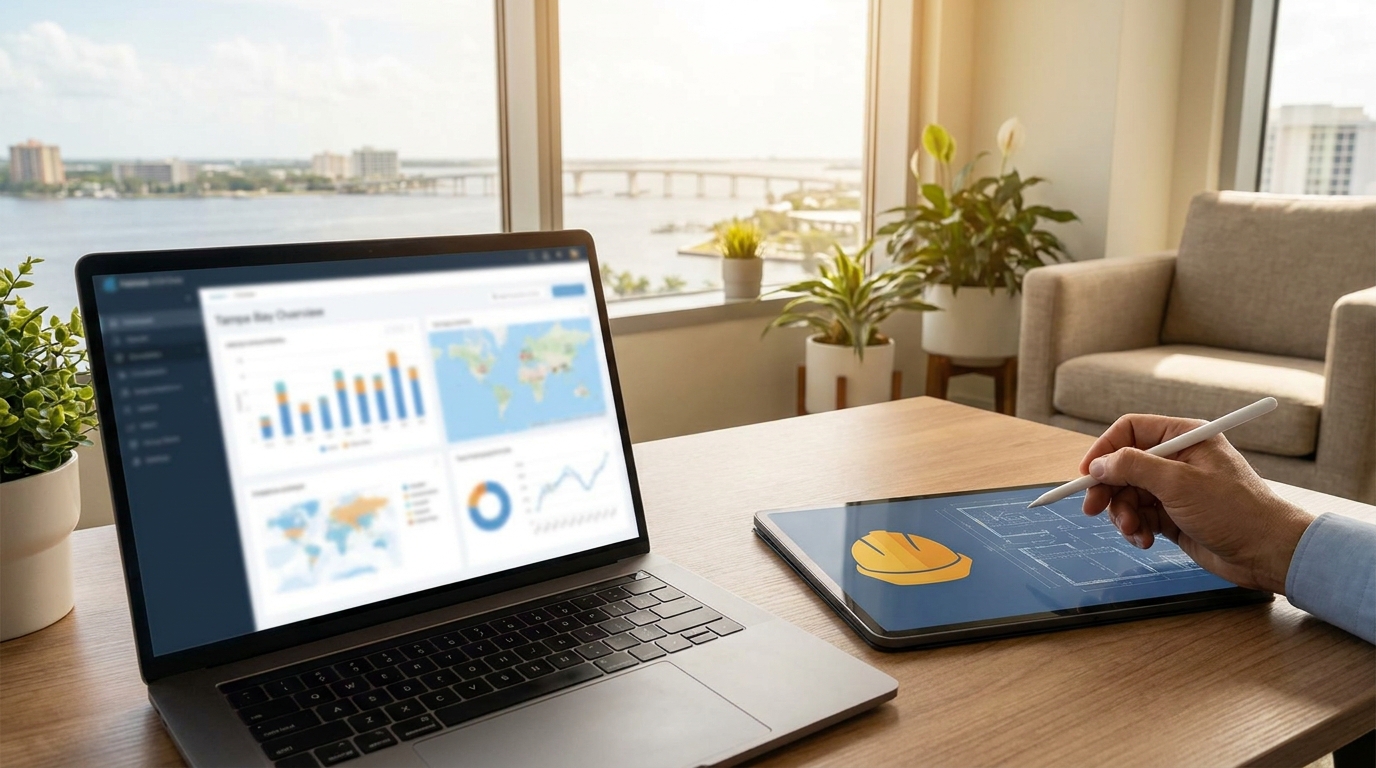
A homeowner in South Tampa types "best contractor for a primary suite addition near Bayshore" into ChatGPT. Three names come back. Yours isn't one of them. That's the new reality of contractor discovery in Tampa Bay — and it's why understanding AI recommendation engine optimization in Tampa has moved from a nice-to-have to a competitive necessity.
Traditional search rankings still matter, but they're no longer the whole game. Google AI Overviews, Gemini, Perplexity, and ChatGPT are now intercepting homeowner queries before users ever scroll a results page. These systems don't "rank" contractors — they synthesize an answer from sources they trust, then recommend a handful by name. If your business isn't in the source pool, you don't exist in the conversation.
How AI Engines Actually Choose Local Contractors
AI recommendation engines aren't running a single algorithm. They're aggregating signals from across the open web, then constructing what amounts to a consensus answer. For a Tampa contractor, three signal categories carry the most weight.
1. Structured content the AI can parse
Large language models prefer content that's explicit about who, what, and where. That means Contractor schema markup, FAQPage schema, project portfolio pages with named neighborhoods, and clear service descriptions. Vague "we do quality work" copy is invisible to these systems. Specific copy — "licensed residential contractor serving Hyde Park, Seminole Heights, and Westchase, specializing in second-story additions under Hillsborough County permit code" — is exactly what AI engines extract and cite.
2. Multi-platform consensus
AI systems weight a recommendation higher when multiple independent sources agree. A contractor mentioned only on their own website is a single data point. A contractor with a verified Google Business Profile, an active Houzz portfolio, mentions in Florida news outlets, and consistent NAP (Name, Address, Phone) data across directories looks to an AI like a real, established business. Houzz and Google Business Profile are repeatedly identified as high-ROI platforms for Tampa contractors, with AI systems frequently citing both in renovation-related answers.
3. Local authority signals
This is where Tampa Bay AI search gets interesting. AI systems lean heavily on regionally branded news and authority sites when constructing local answers. Some marketing firms — Boardroom PR's Florida Authority Network is one of the more visible examples — have built proprietary networks of 20+ Florida-branded news and press release sites (TampaBayBusinessNews.com, FloridaPressReleases.com, and similar) specifically to manufacture this kind of consensus authority. The premise: if seven Florida-domain sites describe your firm as the go-to ADU builder in the Tampa Bay area, the AI treats that as fact.
What's Different About the Tampa Market
Local AI algorithms behave differently in Tampa than they do in, say, Cleveland — because the underlying query patterns are different. Tampa homeowners are running a distinctive set of searches that AI engines are learning to answer.
Demand for home additions, whole-home renovations, and ADU construction is surging across Tampa's suburban markets, driven by homeowners who can't find or afford new construction that meets their needs. That's pushing query volume toward long-tail questions: "Can I build a mother-in-law suite in Hillsborough County?" "What's the permit timeline for a second-story addition in Tampa?" "Do I need a state-licensed contractor for a $60,000 kitchen remodel in Florida?"
AI engines answer those questions by pulling from sites that have already addressed them — in writing, in detail, with the right local context. If your content doesn't explain Hillsborough County's permit process or distinguish between Florida state contractor licensure and county registration, the AI has no reason to surface your business when those questions come up.
Florida's large retiree population and steady influx of high-income domestic migrants also tilt the market toward high-ticket projects — $25,000 and up — with decision cycles that run three to twelve months. That long nurture window makes AI citation especially valuable: the homeowner who asks Perplexity a financing question in February may not sign a contract until October, but they'll remember the firms that kept appearing in their research.
The Regulatory Layer You Can't Ignore
Florida requires residential contractors to hold valid state or county licenses, and AI-optimized marketing content needs to reflect that clearly. Two practical implications:
- Licensing must be explicit in your content. AI systems are increasingly cautious about recommending contractors without verifiable license signals. License numbers, the issuing authority, and scope of work should appear on your service pages.
- FDUTPA still applies. Florida's Deceptive and Unfair Trade Practices Act governs marketing claims, including the AI-optimized variety. Inflated timelines, vague financing promises, or unsubstantiated "guaranteed" outcomes can create exposure regardless of whether the claim was written for humans or for an LLM.
- Permit content earns citations. Tampa-specific guidance on Hillsborough County permit processes, HELOC and FHA 203k financing, and contractor licensing requirements consistently performs well as AI-citable material because it answers questions homeowners are actually asking.
Florida does not currently impose specific regulations on AI recommendation platforms or AEO practices beyond general consumer protection law — but that's a moving target worth watching.
Practical Steps for Tampa Contractors
If you're trying to get cited by AI recommendation engines, the work breaks down into a sequence:
- Audit your structured data. Confirm Contractor schema, LocalBusiness schema, and FAQPage schema are properly implemented on every service page. Without schema, you're asking the AI to guess.
- Fix your NAP consistency. Name, Address, and Phone must match exactly across your website, Google Business Profile, Houzz, BBB, Yelp, and every directory you've ever touched. Inconsistencies are a documented trust penalty.
- Build project portfolio pages by neighborhood. Not just "Tampa" — South Tampa, Westshore, Carrollwood, Brandon, New Tampa. Each page should describe the actual project, the permit context, and the timeline.
- Produce educational content on Florida-specific topics. County permit walk-throughs, license verification guidance, financing comparisons. This is the material AI engines pull from.
- Pursue authority placements. Florida-branded news sites, regional trade publications, and Houzz features create the multi-source consensus that local business AI algorithms reward.
Frequently Asked Questions
How long does it take to start appearing in AI recommendations?
Most contractors see initial AI citation movement within 60 to 120 days of implementing structured content and multi-platform consistency. Building durable consensus authority — the kind that holds up across ChatGPT, Gemini, and Perplexity simultaneously — typically takes six to nine months of sustained work.
Is AI recommendation optimization different from SEO?
It overlaps with SEO but isn't identical. Traditional SEO optimizes for ranked search results; AEO and GEO optimize for inclusion in synthesized answers. The technical foundation (schema, site speed, content quality) is shared. The content strategy diverges — AI engines reward explicit, structured, citation-friendly writing more than they reward keyword-optimized prose.
Does Google Business Profile still matter if AI is taking over search?Yes — arguably more than before. AI systems heavily cite Google Business Profile data when answering local contractor queries, and Google Map 3-Pack visibility remains one of the strongest signals an AI uses to validate a local business. Treating it as a legacy directory is a mistake.What about AI chat assistants on contractor websites?
Lead-capture AI chat tools (several Tampa providers offer them, often built on GoHighLevel) solve a different problem: converting traffic you've already earned. They don't directly influence whether AI engines recommend you, but they reduce lead loss after-hours and during high-volume periods, which matters when your AEO investment starts driving inquiries.
Where This Leaves Tampa Contractors
The contractors winning AI recommendations in Tampa Bay right now aren't necessarily the largest firms or the ones spending the most on ads. They're the ones who treated structured content, local authority, and multi-platform consensus as a serious strategic project — usually starting twelve to eighteen months before they wanted results.
If you're a Tampa contractor trying to figure out where your business stands in AI-generated answers, or you want help building the kind of consensus authority that gets cited across ChatGPT, Perplexity, and Google AI Overviews, Askable works with local businesses on exactly this problem. You can reach the team at https://askable.dev to talk through what's working in the Tampa market and where the highest-leverage moves are for your firm.