ai-visibility
Agentic AI Is Now Choosing Businesses for Tampa Consumers—Here's What It Means for Your Business
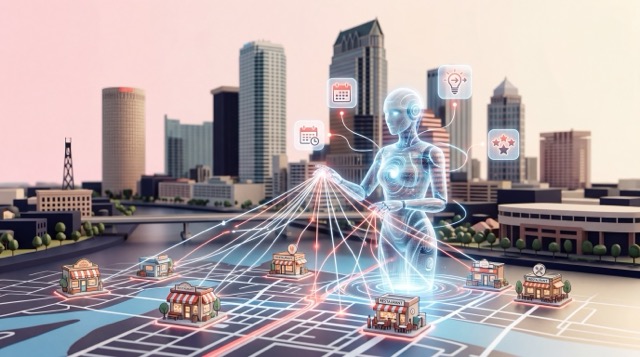
Your business relies on customers finding you. But what happens when the customer isn't searching anymore? What happens when an AI agent is doing the choosing?
Agentic AI has crossed a threshold. It's no longer a chatbot that answers questions. It's an autonomous system that books appointments, compares services side-by-side, validates business credentials, and recommends which restaurant to visit, which lawyer to call, which dentist to trust. In Tampa and across the nation, AI agents are becoming the new middleman between consumer intent and business discovery.
According to Gartner, 40% of enterprise apps will feature task-specific AI agents by the end of 2026. That's not a future scenario anymore. That's now. And if your Tampa business isn't structured for AI agent discovery, you're invisible to a growing segment of high-intent buyers who've delegated their decision-making to algorithms.
The shift: Visibility no longer means ranking in Google for humans. It means being discoverable, evaluable, and recommendable by autonomous AI agents making decisions on behalf of millions of users.
How AI Agents Evaluate Businesses Differently Than Humans
When a human searches for a dentist in Tampa, they scan reviews, look at photos, maybe call the office. When an AI agent evaluates a dental practice, it's operating on a completely different framework.
Entity Recognition and Structured Data
AI agents don't read your website the way humans do. They parse entity data—structured information that tells them: "This is a business. It has a name. It has a phone number. It has coordinates. It has operating hours." If your business information is scattered across your website in unstructured text, the agent has a harder time recognizing you as a valid, complete entity.
Businesses with complete, consistent schema markup—name, address, phone (NAP), hours, services, pricing—rank higher in agent recommendations. A restaurant in Tampa with detailed menu data, reservation systems linked to its profile, and accurate operating hours is more discoverable than one with outdated information buried in a poorly formatted website.
Citation Authority and Trust Signals
Humans trust a business when they see consistent reviews and recommendations. AI agents evaluate citation authority—the breadth and consistency of your business information across trustworthy sources. Are you listed on Google Business Profile? Yelp? Industry directories? Legal databases?
A personal injury lawyer in Tampa with verified credentials on Google, Strong, state bar listings, and legal industry directories has significantly more citation authority than one with minimal digital footprint. AI agents weight these signals heavily when deciding which businesses to recommend to users asking, "I need a lawyer," or "I was hurt at work—what are my options?"
Review Signals and Behavioral Data
Humans read reviews; agents analyze them. AI agents look at review volume, recency, sentiment distribution, and response patterns. They detect anomalies (sudden review spikes, fake reviews) and consistency (does your service actually match customer expectations?).
A home services company in Tampa with 300 consistently positive reviews, regular business responses, and 4.8-star rating is prioritized over a company with 50 older reviews and inconsistent service quality signals. Agents are pattern-matching machines, and they're getting smarter at detecting which businesses deliver what they promise.
Importantly, AI agents weight review signals differently than humans do. Agents prioritize recent reviews over older ones, recognizing that current service quality matters more than past performance. They heavily favor specific, detailed reviews that mention actual services received (e.g., "I had a root canal procedure and the team was professional and painless") over generic praise. Agents also evaluate business response patterns—does the company respond to negative reviews professionally? Do they address concerns? Are responses timely? Businesses with active, thoughtful engagement patterns rank significantly higher because agents infer that responsive businesses care about customer outcomes. A Tampa law firm with dozens of five-star reviews but zero business responses may rank lower than a firm with slightly fewer reviews but consistent, substantive engagement with clients.
Real-world impact: HubSpot's 2026 research shows that 58% of marketers report AI-referred visitors convert at higher rates than organic or paid traffic—because they're already pre-screened and validated by an intelligent system.
Tampa Businesses: Where Agentic AI Is Already Reshaping Discovery
Restaurants and Hospitality
A Tampa resident uses an AI agent: "I have 30 minutes for lunch near downtown. I want outdoor seating, fresh seafood, under $25, and availability now." The agent doesn't browse Yelp the way humans do. It pulls from structured business data, parses real-time reservation systems, cross-references menu information, evaluates ratings, and surfaces the three best options.
A restaurant with complete menu data, integrated reservation system, accurate outdoor seating info, and consistent reviews wins. One with a beautiful website but no menu API, no reservation integration, and sparse schema data is invisible—even if it's fantastic.
Tampa's diverse hospitality landscape—from Bayshore Boulevard's upscale waterfront dining to Ybor City's historic Cuban and Latin restaurants, the SoHo district's craft breweries and contemporary cuisine, and Westchase's business-focused establishments—creates intense competition for AI agent visibility. Restaurants with detailed menu schemas, real-time reservation integrations, accurate cuisine categorization, price transparency, and high review velocity dominate agent recommendations across all neighborhoods. A restaurant lacking this structured data, regardless of location or reputation, remains invisible to AI agents directing high-intent diners.
Home Services
A homeowner in Tampa needs plumbing repairs. They ask their AI agent, "Find me the best plumber available tomorrow morning. Check licensing, reviews, and price estimates." The agent evaluates multiple factors: licensing verification, service area coverage, availability data, past customer outcomes (inferred from review sentiment), and transparency on pricing.
Companies that list service areas, verify licenses publicly, show response times, and maintain current availability data rank higher than those relying on word-of-mouth and basic Yelp presence.
Legal Services
Someone injured in a car accident in Tampa asks an AI agent: "I was hit by another car. What are my options? Who should I call?" The agent evaluates personal injury lawyers by practice area match, bar standing, case outcomes (inferred from reviews and online presence), service area, and fee structure transparency.
As we've covered in our deeper analysis on AI visibility for personal injury lawyers, firms with clear practice area definitions, transparent fee information, established authority signals, and responsive review management dominate AI agent recommendations.
Dental and Medical Practices
A patient in Tampa needs a new dentist. They tell their AI agent: "Find me a dentist that takes my insurance, has evening appointments, and has great reviews." The agent matches patient requirements against structured business data: insurance networks, operating hours, services offered, patient satisfaction signals.
Practices with complete, current insurance information, clear appointment availability, and consistent positive patient feedback are discovered and recommended. Those with incomplete information or poor review velocity fade from agent recommendations.
The Scale of This Shift: Why It Matters Now
ChatGPT alone has over 900 million weekly active users. Add Claude, Gemini, Microsoft Copilot, and emerging enterprise AI agents, and you're looking at a multi-billion user base that's already delegating decisions to AI.
Gartner predicts that by 2028, 60% of brands will use agentic AI for 1:1 interactions with customers. That's not brand-to-consumer interaction through human reps. That's brand visibility and discovery through autonomous agents that evaluate, compare, and recommend on behalf of users.
For Tampa businesses, this is an inflection point. The businesses that are optimized for agent discovery—with structured data, complete citations, transparent information, and strong review signals—will capture this growing segment of high-intent buyers. Those that rely on traditional SEO and human-centric visibility will see AI-referred traffic bypass them entirely.
The urgency is real: If your Tampa business isn't discoverable by AI agents today, you're already losing market share to competitors who are. And the gap only widens as adoption accelerates.
How Askable Tracks AI Visibility for Tampa Businesses
This is where the visibility gap becomes measurable. Askable tracks how your Tampa business appears across AI agent platforms and discovery systems—not just Google.
- Agent Discoverability Audit: We analyze whether AI agents can find your business, parse your information, and include you in recommendations. This includes schema markup verification, structured data completeness, and API connectivity.
- Citation Authority Mapping: We track your presence across authoritative directories, industry databases, and verification systems that agents prioritize. Incomplete or inconsistent citations reduce your ranking in agent recommendations.
- Review Signal Analysis: We evaluate your review presence, sentiment, velocity, and behavioral patterns that agents use to validate trustworthiness and service quality.
- Competitive Positioning: We benchmark your AI visibility against competitors in your industry and geography. Are you being recommended over them? Why or why not?
- Continuous Monitoring: AI platforms evolve. We track changes in how agents evaluate and rank businesses, ensuring your visibility strategy stays ahead of the curve.
This goes beyond traditional SEO audits. As outlined in our post on the AEO-SEO paradox for law firms, the rules of visibility have fundamentally changed. Your business needs both human discoverability and agent discoverability—and they require different strategies.
Five FAQs on Agentic AI and Local Business Discovery
1. How do AI agents currently decide which businesses to recommend?
AI agents evaluate businesses using a multi-factor algorithm that goes far deeper than human search behavior. The evaluation begins with structured data completeness—schema markup, NAP consistency (name, address, phone), service categories, operating hours, and pricing information. Agents then assess citation authority across trusted platforms: Does your business appear on Google Business Profile, Yelp, industry-specific directories, state licensing databases, and professional credentialing sites? Inconsistencies or missing citations signal to agents that your business may be incomplete or unverified.
Next, agents analyze review signals—volume (is there enough data to trust?), recency (are customers still happy?), sentiment distribution (is feedback consistently positive or mixed?), and response patterns (does the business engage with feedback?). Agents also verify trust indicators: license verification, credential validation, background checks where applicable, and whether warnings or complaints exist in public records. Finally, agents match user requirements against business capabilities. If a user needs "a plumber in South Tampa available this week," the agent scores businesses on service area accuracy, real-time availability data, and likelihood of meeting that specific request. Businesses with complete, consistent, and verifiable information across all these dimensions rank highest.
2. Can my Tampa business rank well with Google but be invisible to AI agents?
Absolutely—and this is perhaps the most dangerous scenario for Tampa businesses. Google ranking and AI agent visibility operate on completely different ranking factors. A business can dominate Google search results through strong traditional SEO (keyword optimization, quality backlinks, content authority) while being completely invisible to AI agents that rely on machine-readable data structures.
Google's human-focused algorithm rewards content depth, topical authority, and domain credibility. AI agents, by contrast, require structured data, complete citations across trusted platforms, verifiable credentials, and real-time data integrations. A Tampa consulting firm might have an excellent website with hundreds of high-quality blog posts and strong backlinks—excellent for Google rankings. But if that same firm lacks schema markup, incomplete citations in professional directories, no verified credentials, and no structured service information, AI agents searching for "strategy consultant Tampa" will skip them entirely, even though they rank on page one of Google.
This gap explains why organic visibility can appear strong while AI agent visibility lags. The solution requires distinct optimization strategies: human visibility tactics (keywords, content, backlinks) AND agent visibility tactics (structured data, citations, data completeness, verifiable information).
3. What's the first step a Tampa business should take to optimize for AI agent discovery?
Start immediately with an AI agent visibility audit. This is different from an SEO audit. You need to verify that your business has complete, correctly-formatted schema markup (JSON-LD structured data) on your website that clearly defines your business type, services, hours, and location. Check that your NAP information (name, address, phone) is identical across Google Business Profile, Yelp, your website, and all relevant industry directories.
Next, conduct a citation audit. Map where your business appears: Google, Yelp, industry-specific directories (for lawyers: State Bar listings, Avvo; for doctors: Healthgrades, Zocdoc; for contractors: BBB, Angie's List). Verify that all citations are accurate and complete. Create citations in authoritative directories where you don't yet appear—this builds citation authority that agents recognize as trust signals.
Finally, audit your review presence and engagement. Do you have reviews on Google, Yelp, and industry-specific platforms? Are you responding to them? Update all service and product information to match what agents will evaluate. These foundational elements are what agents use to understand and recommend your business. Without them, no amount of traditional marketing will improve your AI visibility.
4. Does being invisible to AI agents impact revenue directly?
Yes—dramatically. As AI agent adoption accelerates (900M+ weekly ChatGPT users, Gartner's 40% enterprise adoption prediction by 2026, emerging agents like Claude, Gemini, and enterprise tools), more customers are delegating business discovery directly to AI systems. These aren't incidental users—they're typically high-intent, decision-ready buyers who've chosen to use AI to shortcut their research process.
If you're invisible to those agents, you lose access to this growing segment entirely. A Tampa business that's invisible to AI agents is making a bet that all customer discovery will continue flowing through Google search and traditional channels indefinitely. That's a bet with declining odds. Every month, more users—especially younger, tech-forward segments—experiment with AI agents for business decisions. If they don't see your business recommended by an agent, you don't exist in their decision set.
The revenue impact compounds. Early movers who optimize for AI agent visibility now gain competitive advantage as adoption accelerates. Late movers face a widening visibility gap, meaning competitors appear in more agent recommendations, capture more high-intent traffic, and build stronger market position. The longer you delay, the harder it becomes to catch up. This is the cost of inaction on AI visibility that compounds over time into lost revenue and lost market share.
5. How is AI agent discovery different from traditional local SEO?
Traditional local SEO focuses on ranking in human search results through keyword optimization, backlinks, on-page content, and content authority. Google's algorithm rewards businesses that create valuable content and build trust through external links and reviews. Success in local SEO means appearing at the top of human-visible search results when someone types "dentist near me" or "plumber Tampa."
AI agent discovery focuses on something fundamentally different: machine-readable data, structured information, citation authority, and verifiability. Agents don't care about keyword rankings or content length. They evaluate whether your data is complete, consistent, verifiable, and accessible across authoritative sources. A business can excel at local SEO (creating great content, building backlinks, ranking high in Google) and simultaneously fail at agent discovery (missing structured data, incomplete citations, poor data consistency).
Modern Tampa businesses cannot ignore either channel. You need human visibility strategies (keywords, content quality, review management) to capture traditional search traffic. You also need agent visibility strategies (structured data markup, citation completeness, data accuracy, verifiable credentials, responsive review engagement) to be discoverable by autonomous agents. These require different tactics and different ongoing optimization work. Businesses that master both will dominate local markets; those optimizing only for traditional SEO will see their competitive advantage erode as agent-driven discovery accelerates.
Ready to Optimize Your AI Visibility?
Find out how your Tampa business ranks with AI agents and what's holding you back from high-intent buyers delegating decisions to autonomous systems.
Get Your AI Visibility Audit →