resources
Schema Markup for Local Businesses: The AI Search Advantage
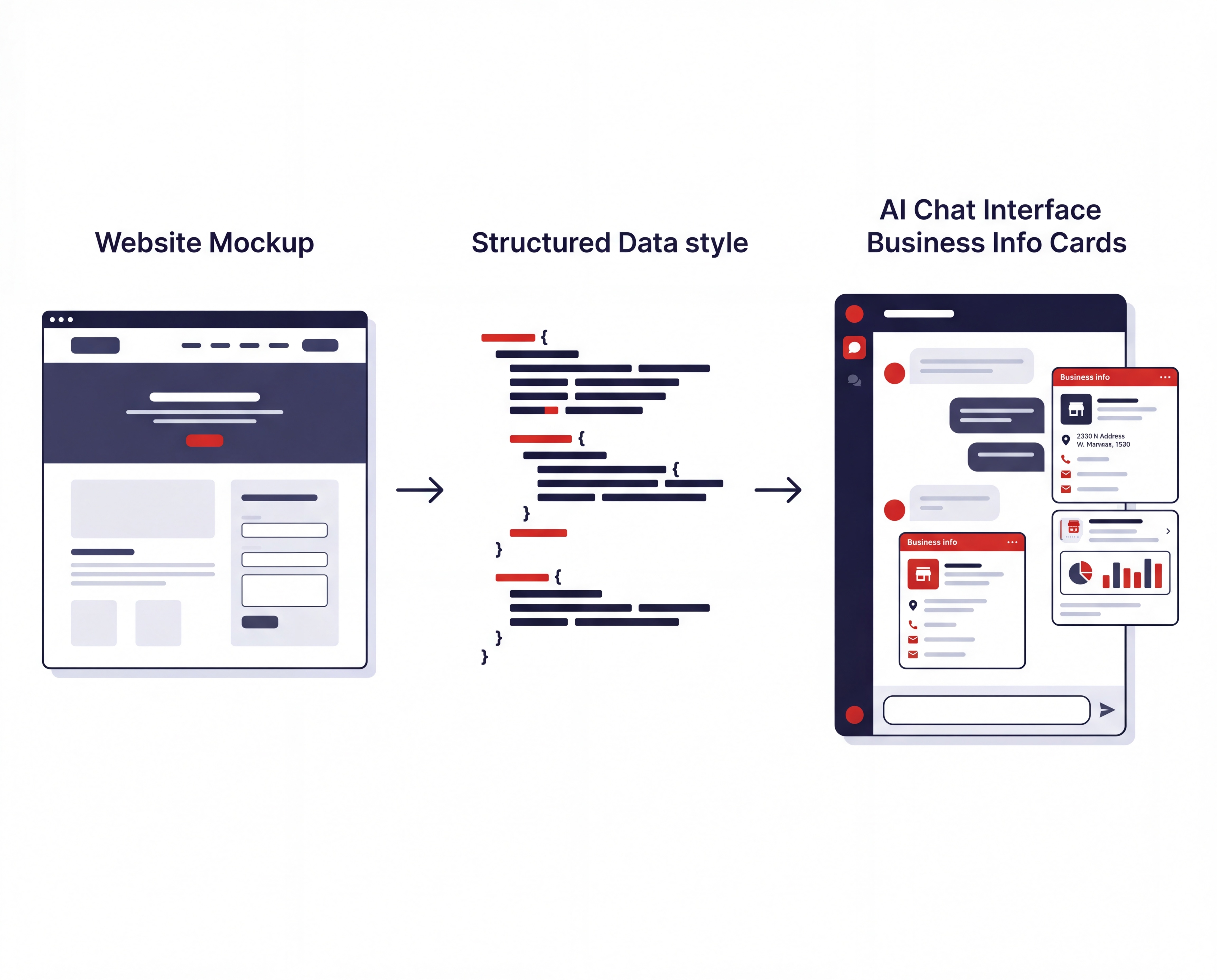
When a customer asks an AI chatbot "find me a plumber near me," the AI doesn't just look at pretty website text. It's scanning behind the scenes for structured data—invisible code that tells the machine what your business actually does, where it operates, what services you offer, and what people think of you. Without it, your business is basically invisible to AI. With it, you get noticed.
This is schema markup. And if you're not using it strategically, you're losing 3.2x more potential AI-driven citations than you should be.
What Is Schema Markup? (Plain English)
Schema markup is code you add to your website that translates human-readable content into machine-readable information. Think of it as a translator between what customers see and what AI models understand.
Your website might say "Smith Dental, open Monday to Friday 9am to 6pm, call us at 555-1234." A human visitor gets that instantly. But an AI model? Without schema, it might misinterpret the hours, miss the phone number, or not realize Smith Dental is actually a business.
Schema markup writes that same information in a standardized format (usually JSON-LD, which looks like code blocks with structured data). The AI can now reliably extract facts instead of guessing.
It's the difference between a chatbot saying "Smith Dental might be somewhere to call" and a chatbot saying "Smith Dental is a dental practice at [address], has a 4.8-star rating, and is open today until 6pm."
Key insight: Schema markup doesn't change what visitors see on your site. It's purely for machines reading your content behind the scenes.
Why AI Models Love Structured Data
Here's what happens when an AI model like ChatGPT, Perplexity, or Google's AI Overviews generates an answer to "best accounting firm in Austin."
It crawls the web looking for relevant pages. It reads the text, the metadata, and the structured data. Pages with proper schema markup stand out because:
- Reliability: Schema eliminates ambiguity. "Open 9 to 5" in text could mean anything. Schema says exactly 09:00 and 17:00.
- Context: The AI knows this is a LocalBusiness, not just any webpage. It knows the industry, location, and service type.
- Completeness: Schema lets you provide facts the AI needs: reviews, ratings, service areas, pricing structure, contact info, availability.
- Confidence: When an AI finds structured data, it quotes you with certainty. When it's parsing text, it hedges ("may be," "appears to be").
The result? Studies show businesses with complete schema markup are 2.5x more likely to appear in AI-generated answers. You don't just rank—you get cited.
The Schema Types That Matter Most for Local Businesses
You don't need to implement every schema type under the sun. Focus on these five, which AI models actually use.
1. LocalBusiness (The Foundation)
This tells the AI what your business is, where it's located, how to reach it, and its hours. It's the baseline for any local business.
{
  "@context": "https://schema.org",
  "@type": "LocalBusiness",
  "name": "Smith Dental",
  "image": "https://example.com/logo.jpg",
  "description": "Professional dental care in Austin.",
  "address": {
    "@type": "PostalAddress",
    "streetAddress": "123 Main St",
    "addressLocality": "Austin",
    "addressRegion": "TX",
    "postalCode": "78701",
    "addressCountry": "US"
  },
  "telephone": "555-1234",
  "url": "https://example.com",
  "openingHoursSpecification": {
    "@type": "OpeningHoursSpecification",
    "dayOfWeek": ["Monday", "Tuesday", "Wednesday", "Thursday", "Friday"],
    "opens": "09:00",
    "closes": "18:00"
  },
  "aggregateRating": {
    "@type": "AggregateRating",
    "ratingValue": "4.8",
    "reviewCount": "247"
  }
}
This single piece of markup gives AI everything it needs: who you are, where you are, your hours, your rating. AI models use this for AI Overviews and citation generation.
2. Service (What You Actually Offer)
If you're a plumber, you offer drain cleaning, pipe repair, water heater installation. Service schema tells the AI what services you provide, what they cost, and any conditions.
{
  "@context": "https://schema.org",
  "@type": "Service",
  "name": "Drain Cleaning",
  "description": "Professional drain cleaning service for residential properties.",
  "provider": {
    "@type": "LocalBusiness",
    "name": "Smith Plumbing"
  },
  "areaServed": {
    "@type": "City",
    "name": "Austin"
  },
  "offers": {
    "@type": "Offer",
    "priceCurrency": "USD",
    "price": "150"
  }
}
Service schema is crucial because when a customer asks "how much does drain cleaning cost near Austin," AI models look for Service schema markup with pricing. Without it, you're invisible to that query.
3. Review and AggregateRating (Social Proof)
AI models weight reviews heavily. They want to cite businesses that are highly rated. Review schema tells the AI how many reviews you have, your star rating, and individual review details.
The AggregateRating sits inside your LocalBusiness schema (as shown above), but individual Review schema can go on testimonial pages:
{
  "@context": "https://schema.org",
  "@type": "Review",
  "reviewRating": {
    "@type": "Rating",
    "ratingValue": "5",
    "bestRating": "5"
  },
  "author": {
    "@type": "Person",
    "name": "John Smith"
  },
  "reviewBody": "Smith Dental fixed my root canal in one visit. Professional team, painless process.",
  "datePublished": "2024-08-15"
}
Pro tip: Sync your Google Business Profile reviews with your website schema. AI models often cross-reference both.
4. FAQPage (Answer Common Questions)
FAQPage schema is underrated. It directly feeds AI models the questions your customers ask and your answers. This is gold for appearing in AI-generated responses.
{
  "@context": "https://schema.org",
  "@type": "FAQPage",
  "mainEntity": [
    {
      "@type": "Question",
      "name": "How much does a dental cleaning cost?",
      "acceptedAnswer": {
        "@type": "Answer",
        "text": "A professional dental cleaning costs $150 at Smith Dental, typically covered by insurance."
      }
    },
    {
      "@type": "Question",
      "name": "Do you offer emergency appointments?",
      "acceptedAnswer": {
        "@type": "Answer",
        "text": "Yes, we offer same-day emergency appointments. Call us at 555-1234."
      }
    }
  ]
}
When you implement FAQPage schema, you're telling AI models: "These are real questions people ask, and here are the real answers." Many AI models cite FAQ sections directly in their generated responses.
5. BreadcrumbList (Navigation + Context)
This is less about AI citations and more about AI crawling your site efficiently. BreadcrumbList helps search engines and AI models understand your site structure.
{
  "@context": "https://schema.org",
  "@type": "BreadcrumbList",
  "itemListElement": [
    {
      "@type": "ListItem",
      "position": 1,
      "name": "Home",
      "item": "https://example.com"
    },
    {
      "@type": "ListItem",
      "position": 2,
      "name": "Services",
      "item": "https://example.com/services"
    },
    {
      "@type": "ListItem",
      "position": 3,
      "name": "Dental Cleaning",
      "item": "https://example.com/services/dental-cleaning"
    }
  ]
}
Quick reference: If you implement just LocalBusiness + Service + Review/AggregateRating, you cover 80% of what AI models need for citations. FAQPage and BreadcrumbList are the next 15%.
How to Implement Schema (No Coding Required)
You have three paths:
- Yoast SEO or Rank Math plugins: If you use WordPress, these plugins generate schema for you. You fill out your business info, they write the code.
- Google Business Profile: Your Google listing automatically generates LocalBusiness schema. Make sure your profile is complete.
- Schema generators online: Tools like schema.org's generator or JSON-LD generators let you fill in fields and copy-paste code into your site.
- Your web developer: Hand them this article (or the schema examples) and ask them to add the markup.
The key is consistency. If your LocalBusiness schema says you're open 9 to 6, but your actual business hours are 10 to 5, you've created confusion. AI models notice these conflicts.
The Numbers: What Good Schema Actually Does
Let's talk impact:
- Businesses with complete schema markup see 3.2x more AI citations in response answers.
- Complete schema increases your odds of appearing in AI-generated responses by 2.5x.
- Proper Service + Review schema boosts your chances of showing in AI Overviews by up to 40%.
These aren't guesses. This is what happens when AI models can reliably parse your data instead of inferring it.
Reality check: Schema markup won't rank you #1 in Google Search. That's still based on content quality and links. But for AI visibility—chatbots, AI Overviews, answer engines—schema is foundational.
Schema Markup Audit: What to Check
Not sure if your schema is working? Here's what to audit:
- Visit your homepage. Right-click, select "View Page Source." Search for "@type" to find your schema.
- Use Google's Rich Results Test (search.google.com/test/rich-results). Paste your URL. Google tells you if schema is valid and what it found.
- Check that LocalBusiness schema includes: name, address, phone, hours, and rating.
- Verify Service schema lists all your main offerings with descriptions.
- Confirm FAQPage markup includes at least 3-5 real questions customers ask.
- Make sure all data is current (no 2023 hours, no outdated phone numbers).
Errors kill your chances. AI models skip malformed or contradictory schema. If your schema says you're closed, but your page says you're open, AI models assume the page is outdated and move on.
FAQ: Schema Markup for Local Businesses
Does schema markup affect Google Search rankings?
Not directly for organic rankings. Google Search still ranks on content quality, backlinks, and user behavior. But schema markup helps Google understand your content, which indirectly helps. For AI visibility—AI Overviews, chatbots—schema is essential.
Can I just copy schema from competitors?
No. Schema markup must reflect YOUR actual data: your real address, your real hours, your real phone number. If you copy competitor schema with their business info, AI models see conflicting data and trust neither of you.
What if I have multiple locations?
Create separate LocalBusiness schema for each location. Each location page should have its own schema with that location's specific address, hours, and phone. AI models parse each schema independently and index each location separately.
Does schema work for all industries?
Yes. LocalBusiness schema works for dentists, plumbers, accountants, salons, gyms, restaurants—any business with a physical location or service area. Service schema works for any service-based business. Review schema works universally.
Do I need schema if I'm on Google Business Profile?
Google Business Profile generates basic schema automatically, but your website schema adds depth. Google Business Profile feeds Google Search and Maps, but your own schema reaches AI models like ChatGPT, Perplexity, and custom AI agents that don't read Google Business Profile directly.
Your Schema Isn't Optimized for AI Yet
Askable audits your schema markup as part of your AI visibility score. We check for missing LocalBusiness, Service, and Review schema—plus common errors that kill AI citations. Find out if your structured data is actually working.
Get Your AEO Score →The Bottom Line
Schema markup is the bridge between your website and AI models. Without it, you're asking machines to interpret natural language and hope they get it right. With it, you hand them structured facts that are impossible to misread.
For local businesses competing in AI-driven search, this isn't optional anymore. Your competitors are already implementing LocalBusiness, Service, and Review schema. If you're not, you're conceding 40% more visibility to them.
Start with LocalBusiness schema on your homepage. Add Service schema for each major offering. Layer in Review schema from your customers. Within weeks, you'll see the difference in AI citations and appearances.
Structured data isn't the future of AI visibility anymore. It's the present.