ai-visibility
80% of Searches Now End Without a Click: The Zero-Click Crisis Crushing Orlando Businesses
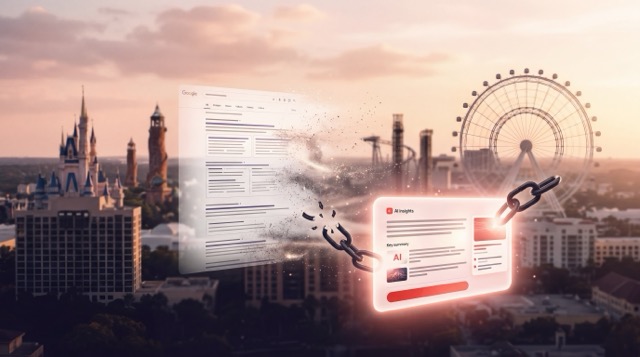
80% of searches end without a single click. Not 80% of bad searches. Not 80% of competitive keywords. All searches. In 2026, the search landscape has fundamentally shifted—and most Orlando businesses haven't noticed yet. While they're still optimizing for rankings, Google AI Overviews and search generative AI are answering questions directly in the results page, bypassing the organic listings entirely. For local "near me" searches in hospitality, tourism, and service industries, the zero-click rate climbs to 78%. The old SEO playbook is broken. The new one requires appearing inside the AI answer, not below it.
The Zero-Click Crisis: What the Data Reveals
The numbers are stark. According to Semrush's 2025 research, 58.5% of all US searches end without any click to an organic result. That's more than half of all search queries generating zero traffic to any website. But the crisis runs deeper when you zoom into specific search types.
Local "near me" searches—the lifeblood of Orlando tourism, restaurants, and service businesses—show a 78% zero-click rate according to Similarweb. When a tourist in Orlando searches "Italian restaurants near me" or a resident looks for "HVAC service near me," they're getting their answer directly from Google without ever visiting a website. Meanwhile, when those searches trigger Google AI Overviews, the zero-click rate skyrockets to 83%, with some variations showing 93% zero-click rates in Google AI Mode.
Key insight: Ranking #1 on Google is no longer a guarantee of traffic. Businesses appearing in AI-generated answers capture most clicks. Everyone else gets zero.
For Orlando businesses already ranked in the top positions, the impact is devastating. Research shows that organic CTR dropped 34-61% for queries with AI Overviews. A restaurant that was getting 150 clicks per week from organic search may now see 50. A real estate agent losing 40% of click traffic from "homes for sale near me" searches. A plumber watching zero-click local searches eat their Google visibility alive.
Why Orlando Businesses Are Hit Harder
Orlando's economy depends heavily on two industries that are particularly vulnerable to zero-click search: tourism and local services.
A visitor searching "best theme parks near me" or "where to eat downtown Orlando" is getting a comprehensive AI-generated answer without needing to click through to tourism websites or restaurant sites. The AI Overview lists options, reviews, and hours—everything the searcher needs is on the results page. For theme parks, hotels, and attractions, this means reduced traffic to their sites where they could upsell experiences, capture email addresses, or influence customer decisions.
Orlando's theme park and hospitality sector faces a uniquely challenging situation. When a visitor arrives in Orlando and searches "best things to do today" or "family restaurants near Walt Disney World," they're met with AI-generated lists featuring multiple attractions and dining options side by side. This eliminates a critical advantage that Orlando's major attractions once held: being the destination itself. Smaller attractions, boutique hotels, and specialty restaurants that relied on being "discovered" through search now compete on equal footing in AI answers, stripped of their own narrative and marketing advantage. The clicks that do materialize go disproportionately to businesses with the highest review scores and citation consistency—metrics that favor established, larger operators. This structural shift threatens mid-sized tourism businesses and independent hospitality operators who previously competed on unique positioning and website experience.
Service-based businesses—HVAC, plumbing, electricians, medical practices—are equally affected. When someone searches "HVAC repair near me" or "orthopedic surgeon near me," Google's AI now surfaces a few businesses directly in the answer, often based on map listings and citations rather than organic ranking position. A business ranked #3 organically might appear in the AI Overview because it has stronger citation consistency, while the #1 ranked site gets zero clicks.
This represents a fundamental shift from ranking-based SEO to citation-based visibility. Google's AI doesn't primarily pull from your website content anymore—it pulls from structured data, citations, reviews, and the knowledge graph. Your citations across the web are now more valuable than your rankings.
The Shift from Rankings to Citations
For decades, local SEO meant: Rank high in Google Maps and organic search, and customers will find you. That strategy is partially broken in the zero-click world. Now it's: Ensure your business is cited accurately across the web, so the AI chooses you when it answers.
Google AI Overviews pull from:
- Local citations (Google Business Profile, Yelp, Apple Maps, Trustpilot, industry directories)
- Review platforms with verified business information and customer testimonials
- Structured data on your website (schema markup) that Google can interpret
- Knowledge graph entries that Google has built about your business
- Media mentions and third-party sources that mention your business
A business with consistent citations across 20 platforms, strong reviews, and a complete Google Business Profile has a far better chance of being selected by AI than a business ranked #1 organically but with scattered citations and outdated information.
This changes Orlando businesses' priorities entirely. Instead of asking "How do we rank higher?" they should ask "Where does our business appear? How consistent is our information? Are we in the knowledge graph?"
What changed: SEO used to mean "optimize your website to rank." AI Visibility means "ensure your business data is correct, consistent, and cited everywhere the AI looks."
Answer Engine Optimization (AEO): The Bridge
While traditional SEO aimed at ranking websites, Answer Engine Optimization (AEO) aims at appearing in AI-generated answers. For local businesses in Orlando, AEO is the survival strategy in the zero-click era.
AEO includes:
- Citation accuracy and consistency across all platforms where your business appears
- Review quality and quantity from authentic customers, influencing AI selection
- Structured data implementation (schema.org markup) that makes your data machine-readable
- Content that answers specific questions that trigger AI Overviews (FAQs, how-to guides, comparisons)
- Local SEO fundamentals like Google Business Profile optimization and NAP (Name, Address, Phone) consistency
- Third-party mentions and backlinks that feed into the knowledge graph
For a restaurant in Orlando, AEO means ensuring your business name, address, and phone are identical across Google Business Profile, Yelp, Trustpilot, OpenTable, and your website. It means collecting reviews that mention specific dishes, atmosphere, and service. It means creating FAQ content about your menu, hours, and reservations that Google AI can cite when answering questions.
Read more: The AEO-SEO Paradox: Why Real Estate Agents in Orlando Must Adapt
Zero-Click Search by Industry in Orlando
Tourism & Hospitality
Searches like "best restaurants near Disney World" or "hotels downtown Orlando" trigger AI Overviews that list several options with ratings, photos, and reviews—all on the results page. Tourist traffic that might have gone to your website now stays in Google. See how tourism businesses can win in AI-driven search.
Service-Based Businesses
HVAC, plumbing, electrical, medical, and legal service searches are heavily impacted. "Emergency plumber near me" is almost guaranteed to have AI Overviews listing 3-5 local options. If you're not in that answer, you're invisible.
Restaurants & Retail
Restaurant searches trigger maps, AI-generated lists, reviews, and photos—all without clicking to the restaurant's website. Learn how restaurants are adapting to AI visibility challenges.
The commonality across all industries: If Google's AI doesn't include you in its answer, your Click-Through Rate drops 34-61%. If it does include you, your citation and review quality determines ranking within the answer.
The Real Cost: Beyond Click Loss
Zero-click searches don't just mean lost traffic. They represent lost:
- Customer relationships — No visit to your website means no email capture, no opportunity to build loyalty
- Brand control — Your brand is represented only by reviews and citations, not your own messaging
- Conversion opportunity — Customers see competitors in the same AI answer and choose based on reviews/ratings, not your value prop
- Data insights — No website visit means no analytics, no understanding of customer behavior
- Upsell potential — A tourist who never visits your website can't discover your premium offerings
For an Orlando business relying on organic search, this is an existential threat. See how AI search is displacing organic traffic competitively.
How to Measure: Citation vs. Ignored
The fundamental question for Orlando businesses is no longer "Are we ranking?" but "Are we being cited by AI, or ignored?" This requires a completely different measurement approach.
Traditional metrics like keyword rankings and organic traffic are increasingly misleading. A business ranked #1 but not cited by AI is actually worse off than a business ranked #5 but appearing in every AI Overview for high-volume queries.
The metrics that matter now:
- AI Citation Rate — How often your business appears in AI-generated answers for your target keywords
- Citation Consistency — How accurately your NAP (Name, Address, Phone) appears across 50+ platforms
- Review Score & Velocity — Are you getting fresh reviews that influence AI selection?
- Knowledge Graph Presence — Is Google maintaining an updated knowledge panel for your business?
- AI Mode Click Share — Of searches in Google AI Mode, what percentage click to your business?
- Answer Box Inclusion — Do you appear in traditional answer boxes for FAQ questions?
Askable measures exactly this: Whether your business is being cited by AI when it matters, and whether your citations are being ignored. This is the new SEO health check. A business with consistent citations, quality reviews, and strong AI visibility will command more traffic (even with 78% zero-click rates) than a business optimized for keyword rankings in the traditional sense.
Stop Chasing Rankings. Start Measuring AI Visibility.
See where your citations appear—and where they're ignored—in AI-generated answers. Track what matters in the zero-click era.
Get AI Visibility Data →FAQ: Zero-Click Searches and Orlando Businesses
1. If 80% of searches don't click through, how do any businesses get traffic?
The 20% that do click are high-intent searches and repeat visitors. Direct searches (typing a business name) have near-zero click loss. Branded searches rarely show AI Overviews. The crisis is in informational and local searches ("best restaurants," "plumber near me"), where 78% zero-click rates dominate. Businesses appearing in AI Overviews still get clicks—just fewer than they used to. This is why citation visibility now matters more than ranking position.
2. Can an Orlando business rank #1 but not appear in AI Overviews?
Yes, absolutely. Google AI Overviews prioritize citations, reviews, and structured data over ranking position. A business ranked #3 with strong citations and reviews might appear in the AI Overview, while the #1-ranked site with poor citation consistency doesn't. This is why tracking "rank" alone is now dangerously incomplete.
3. How do tourism businesses adapt to zero-click search?
Tourism businesses must focus on: (1) being cited in AI Overviews (through reviews, travel directories, and citation consistency), (2) appearing in Google's travel and hospitality answer formats, and (3) capturing attention through brand recognition and distinctive reviews. The goal shifts from "rank high and drive clicks" to "appear in every relevant AI answer and make visitors click based on reviews or curiosity."
4. Is traditional SEO dead?
No, but it's evolved. Ranking still matters for branded, navigational, and high-intent searches. However, informational and local searches—where most traffic used to come from—are now heavily AI-driven. A modern Orlando business strategy must combine traditional SEO (for organic visibility in traditional results) with AEO (for citation and AI visibility). The businesses that do both win.
5. What's the single most important metric to track in the zero-click era?
AI Citation Rate—how often your business appears in AI-generated answers for your target keywords. This single metric shows whether you're visible where customers are actually searching. A business with 60% AI Citation Rate (appearing in 3 out of 5 relevant AI Overviews) will outperform a business with perfect keyword rankings but zero AI visibility. Measure, optimize, and track this obsessively.