ai-visibility
Tourists Are Asking AI for Restaurant Recommendations in Orlando — Not Yelp
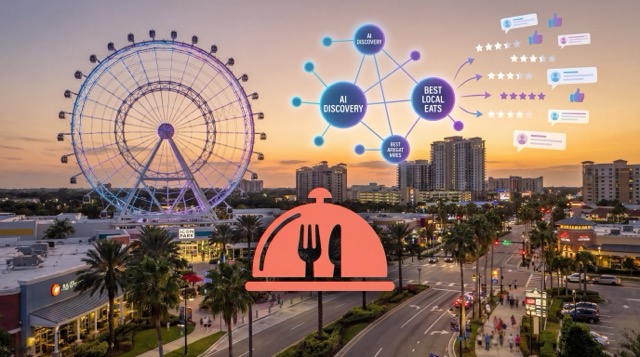
Over 75 million tourists visited Orlando last year. A growing number of them, before choosing a restaurant, did something their predecessors never did: they asked an AI. Not "best restaurants near Disney Yelp" typed into Google. They opened ChatGPT on their phone at the hotel and said, "Where should we eat tonight near Disney Springs? We have kids and want something local, not a chain." And ChatGPT named two or three restaurants. Then they made a reservation.
Here is the contrarian reality that most Orlando restaurant owners have not yet confronted: your thousands of Yelp reviews might be close to irrelevant for AI recommendations. Not because the reviews are bad — but because AI does not trust Yelp as a citation source the way tourists used to trust it as a discovery tool. AI checks different platforms, reads review content differently, and decides which restaurants to recommend based on signals that have almost nothing to do with your star count on any single platform.
Food and drink has seen the fastest AI Overview growth of any local business vertical in 2025. Which means Orlando restaurants — serving the most tourist-intensive market in the United States — are at the absolute center of this disruption. If AI is not recommending your restaurant when tourists ask where to eat, your competition for that family's dinner dollar is essentially over before it begins.
The scale of tourist AI adoption: 27% of consumers have used AI to find a local business in the past week (Youtech survey). In a city with 75 million annual visitors, that is tens of millions of potential dining decisions being routed through AI — and AI recommends 2-3 restaurants per query, not a list of 50.
The Problem With How Orlando Restaurants Think About Reviews
The old tourist discovery playbook made sense for its era: get on Yelp, get on TripAdvisor, accumulate reviews, appear in "top restaurants" listicles, maybe get a local press mention. Orlando restaurants spent years and significant marketing budget optimizing for this funnel. And for a long time, it worked. Tourists scrolled, filtered by rating, and picked from the top results.
AI changed the architecture of that decision. When a family from Ohio staying at a resort near Universal Studios asks ChatGPT "where's the best seafood in Orlando for dinner tonight," AI does not redirect them to Yelp. It answers directly. And here is what the research shows: 60% of AI Overview citations for local queries like this point to third-party publishers — food blogs, local guides, travel publications — not the restaurant's own website and not their Yelp page. The restaurant with 4,000 Yelp reviews but no presence in local food publications and no structured data on its website may be completely invisible to AI despite being beloved by actual diners.
Meanwhile, a smaller restaurant in Thornton Park or the Mills 50 district with 300 Google reviews, a well-maintained Google Business Profile with menu items and photos, and two or three mentions in respected Orlando food publications might be the one AI recommends to a visitor who has never heard of it. The review volume advantage that dominant restaurants spent years building does not transfer to the AI era the way they assumed it would.
What AI Actually Evaluates When Tourists Ask for Orlando Restaurants
Review Sentiment and Specific Language — Not Star Ratings
AI reads the actual text of your reviews and extracts semantic signals. It is looking for specific mentions of food quality, atmosphere, service speed, signature dishes, and value. A restaurant where reviews consistently use words like "fresh fish," "waterfront views," "attentive staff," and "worth the wait" builds a rich semantic profile that AI can match against specific tourist queries. A restaurant with hundreds of reviews containing only "great food!" and a star rating is informationally thin from AI's perspective — there is no content to match against "best seafood with outdoor seating in Orlando."
How you respond to reviews also matters. BrightLocal found that 50% of consumers say templated review responses make them unlikely to choose a business — and AI has absorbed this preference. Restaurants whose owners respond with genuine, specific replies signal authenticity that AI weights in recommendation decisions, especially for the high-stakes dinner choice a tourist makes once during their vacation.
Structured Data and Website Content
Many Orlando restaurants have beautiful websites with stunning food photography and not a single piece of structured data that AI can read. No schema markup identifying cuisine type, price range, hours, or menu items. No clear content answering questions tourists actually ask: "Is it good for large groups?" "Do they have outdoor seating?" "Is there parking near the restaurant?" "Can I make same-day reservations?" AI is trying to answer these questions on behalf of the tourist. If your website does not contain the answers in a structured, readable format, AI cannot use you as the answer — even if you have the best peel-and-eat shrimp in Orange County.
Third-Party Publisher Presence
Because 60% of AI citations for local queries point to third-party sources, appearing in the right publications is arguably more important than your own website for AI recommendation purposes. For Orlando restaurants, this means the Orlando Weekly food section, Eater Orlando, Visit Orlando's dining guides, local lifestyle blogs, and travel publications that cover Florida dining. A restaurant mentioned and described in detail in three of these sources is far more likely to be recommended by AI than one with a beautifully designed website that no one has written about.
The conversion advantage you are missing: Visitors who arrive from LLM platforms convert at 4.4 times the rate of traditional organic visitors (Semrush). A tourist who followed ChatGPT's restaurant recommendation to your website has already committed mentally — they are looking for confirmation, not comparison shopping.
The Orlando Market Is Uniquely Exposed
Most restaurant markets have a mix of tourist and local traffic. Orlando is extreme — enormous volumes of tourists who are entirely unfamiliar with the city and making dining decisions in real time, often on their phones at the hotel after a long day at a theme park. These tourists are exactly the demographic most likely to turn to AI for recommendations because they have no local knowledge, no trusted friends to ask, and no time to scroll through 300 Yelp reviews.
International tourists — and Orlando draws visitors from dozens of countries, particularly from Brazil, the United Kingdom, and Canada — are even more likely to use AI translation and recommendation tools simultaneously. A family from São Paulo asking AI in Portuguese where to eat near I-Drive is an entirely different interaction than a local Orlandoan checking Google Maps. But the restaurant that shows up in AI's Portuguese-language answer to that query wins the table. Most Orlando restaurants have no idea whether they appear in those queries at all.
84% of consumers search daily for local businesses, and the trend is clearly moving toward AI-mediated search for these decisions. Askable tracks exactly how your restaurant appears when tourists ask AI for Orlando dining recommendations — across ChatGPT, Perplexity, Google AI Overviews, and Claude. It shows you the specific queries where competitors are being recommended instead of you, the gaps in your structured data and publication presence that AI is using to make that decision, and what to fix. Orlando restaurants competing for 75 million annual tourist dollars cannot afford to leave this visibility unmeasured.
Other Orlando business categories are navigating the same shift. How AI recommends Orlando attorneys follows identical logic — third-party citations and structured data consistency matter more than ad spend. The broader pattern of how AI is displacing traditional search for Orlando businesses is captured in our analysis of AI search competitive displacement in Orlando.
Is AI Recommending Your Orlando Restaurant?
Find out exactly where you appear when tourists ask ChatGPT where to eat in Orlando — and what to fix to get more of those recommendations.
Check Your AI Visibility →Frequently Asked Questions
Does ChatGPT actually recommend specific restaurants in Orlando?
Yes, and with increasing specificity. When tourists ask questions like "where should we eat near Disney Springs tonight" or "best seafood restaurants in Orlando with outdoor seating," AI responds with two to three specific restaurant recommendations — not a link to Yelp. These recommendations are based on the restaurant's structured data, review sentiment, publication mentions, and Google Business Profile completeness, not simply star ratings or review volume.
My restaurant has thousands of Yelp reviews. Why might I still be invisible to AI?
Yelp is not a primary citation source for most AI platforms when making restaurant recommendations. Research shows that 60% of AI citations for local queries point to third-party publishers like food blogs, local guides, and travel publications — not Yelp or TripAdvisor. A restaurant with thousands of Yelp reviews but no presence in local Orlando food publications, no schema markup on its website, and an incomplete Google Business Profile may be nearly invisible to AI despite an impressive Yelp presence.
What does AI look for when recommending an Orlando restaurant to tourists?
AI evaluates several signals: review sentiment and specific language (mentions of signature dishes, atmosphere, service quality), structured data on your website (schema markup for cuisine, hours, price range, menu), completeness of your Google Business Profile including photos and Q&A responses, presence in respected local and travel publications that AI trusts as citation sources, and consistency of your business information across all platforms where you are listed.
How important are publication mentions versus my own website content?
For AI recommendations, third-party publication mentions may be more important than your own website content. Because AI trusts authoritative sources more than self-published content, being reviewed and described in detail in Orlando Weekly, Eater Orlando, or major travel publications creates the kind of third-party endorsement that AI uses to validate a recommendation. Your website still matters for structured data and answering specific tourist questions, but it is rarely enough on its own.
How do I find out which AI queries my Orlando restaurant appears in?
Manual testing — asking ChatGPT or Google AI "best restaurants in Orlando near Disney" — gives you a starting point but misses hundreds of query variations tourists actually use, including language variations, neighborhood-specific queries, and cuisine-specific requests. Askable runs automated visibility testing across all major AI platforms and shows you exactly where your restaurant appears, where it does not, and what specific factors are keeping you off AI's recommendation shortlist.