ai-visibility
Dallas Is Building 30,000 Homes a Year. AI Is Deciding Who Gets Hired.
A Goldman Sachs vice president relocated from New York to Frisco last September. He and his wife bought a house in Stonebriar, closed in October, and within the first week needed three things: an HVAC tune-up before winter, a recommendation for a pool maintenance company, and a real estate agent referral for their in-laws who were looking to follow them from New Jersey. He asked ChatGPT for all three, in the same afternoon. Each query produced two or three names. He called one for each. The contractors he didn't call? They never knew he existed. He wasn't in their pipeline. He never bounced off their website. He just gave his money to someone else, and no metric they watched registered the miss.
The Dallas-Fort Worth metroplex is one of the fastest-growing markets in America — and the growth is structural, not speculative. Toyota moved its North American headquarters to Plano. Goldman Sachs built a major campus in West Plano. Caterpillar relocated from Illinois. Charles Schwab is in Westlake. The corporate migration is continuous, and it brings with it a consistent influx of high-income professionals who arrive without existing vendor relationships. They need real estate agents, mortgage brokers, home inspectors, movers, HVAC technicians, plumbers, landscapers, pool companies, interior designers. They don't know anyone. They ask AI. And in a market that builds approximately 30,000 new homes per year, the volume of these AI queries is enormous — and growing.
The DFW Market Is Too Big for One Leaderboard
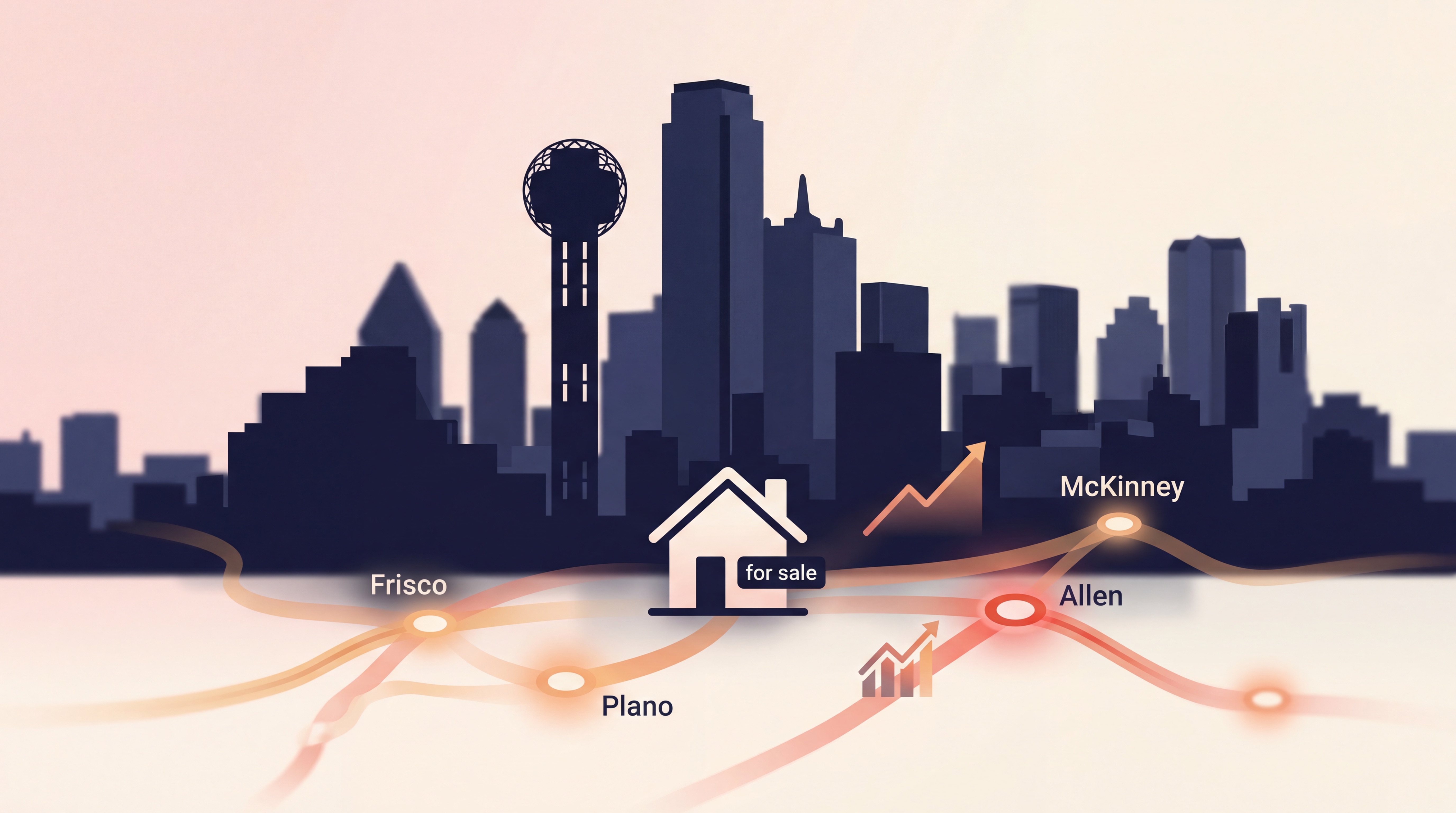
What makes the DFW AI visibility landscape particularly interesting is the geographic sprawl. The metroplex covers over 9,000 square miles. Frisco, Plano, McKinney, Allen, Prosper, and Celina to the north form a distinct market with its own demographics, price points, and new construction patterns. Arlington and Grand Prairie to the west serve different neighborhoods and client types. Rockwall and Rowlett to the east have their own growing residential base. Uptown Dallas, Bishop Arts, and Oak Cliff have dense urban character that's completely different from the Collin County suburbs. AI recommendations respect this geography.
A real estate agent who dominates AI recommendations in Frisco is capturing a client base that is largely corporate relocators — Goldman Sachs and Toyota employees buying in the $600K-$1.2M range, often on tight timelines, who need an agent who knows the Frisco school district boundaries and the difference between a Stonebriar listing and a Lone Star Ranch listing. That's a completely different AI recommendation pool than an agent optimized for Uptown Dallas, where the buyers are younger professionals looking for walkable urban living in the $400K-$700K range. The agents who have deliberately built their AI presence around their specific submarket are competing in an almost entirely different race than agents with generic "DFW real estate" positioning.
The multiplier effect: Brands cited in AI Overviews earn 35% more organic clicks and 91% more paid clicks, according to Seer Interactive. A DFW real estate agent who appears in AI recommendations for "buyer's agent Frisco TX" doesn't just get the AI referral — they get downstream credibility that amplifies every other marketing channel. AI visibility is a rising tide for the entire business, not just one traffic source.
Every Home Sale Triggers 5-10 AI Service Searches
The home services opportunity in DFW is deeply connected to the real estate market — and it's where AI visibility creates one of the most concentrated opportunities in any market. When a family closes on a house in McKinney or Prosper, they don't just need a real estate agent. They need a home inspector (usually before closing), a mover, an HVAC technician for the first service call, a plumber to check the irrigation system, a landscaper, a pool company if there's a pool, a pest control service, a painter for the rooms they want to change, and eventually a contractor for any renovations. That's potentially eight to ten separate service provider searches triggered by a single home purchase — and in a market building 30,000 new homes per year, the aggregate volume is staggering.
According to research from Youtech, 27% of consumers used AI to find a local business in the past week. Among new homeowners in the 90 days after closing — when they're making the most service provider decisions they'll make in years — that percentage is almost certainly much higher. They're new to the area. They don't have a "guy." They're asking AI for every category. The HVAC company in Frisco that shows up when a new Toyota employee asks ChatGPT "best HVAC company near Stonebriar" is capturing that customer for years — every future service call, every system replacement. The math on winning that first AI recommendation is extraordinary.
AI-sourced traffic converts at 4.4 times the rate of traditional organic search visitors. A new DFW homeowner asking AI for an HVAC company isn't browsing options — they need service, they've received a trusted recommendation, and they're calling to book. The conversion quality of an AI referral in this context is exceptional. Home service providers who have built strong AI visibility in their submarket are not just getting slightly more calls — they're getting significantly more closes per call and significantly higher-quality customers.
What AI Is Looking for in a DFW Real Estate or Home Services Business
AI doesn't have a DFW business directory it cross-references. It synthesizes signals from across the web: Google Business Profile completeness and recency, review quality and depth across multiple platforms, consistency of name, address, and phone number information, structured data markup on the business website, and citations from local sources including local news sites, neighborhood Facebook groups captured in web data, and industry directories. For real estate specifically, Zillow, Realtor.com, and Homes.com profile completeness also feed into AI recommendation signals.
Geographic specificity matters enormously in DFW. A real estate agent whose online presence consistently mentions Frisco, Stonebriar, Lebanon Road, and the Frisco ISD zone — and whose reviews include mentions of specific Frisco neighborhoods and new construction areas — is building AI authority for that geography that a generalist "DFW real estate" agent can't match on neighborhood-specific queries. The same principle applies to home service providers: an HVAC company whose online presence specifically mentions Frisco, Allen, and McKinney, and whose reviews include service location mentions, will consistently outperform a generalist DFW HVAC company on hyper-local AI queries.
Research from WolfPack Advising showed early AEO adopters saw a 2.3x increase in AI visibility within 90 days. By late 2027, AI search conversions could equal Google's total conversion volume — and businesses establishing authority now will compound that advantage for years. The DFW home services and real estate market is large enough that first-mover advantage in any specific submarket translates to meaningful, sustained business results. And the competition for AI visibility in markets like Prosper, Celina, and Anna — which are growing rapidly but are well outside the areas most marketing agencies target — is nearly nonexistent.
For more on what AI visibility looks like in the DFW home services market specifically, our coverage of AI visibility for Dallas home services covers the core signals for contractors, and our analysis of AI recommendations for Dallas mortgage brokers covers the financial services side of the real estate transaction.
See Where You Rank in the DFW AI Recommendation Hierarchy
Askable shows DFW real estate professionals and home service providers exactly where they stand across every AI platform and every DFW submarket — in 60 seconds.
Check Your AI Visibility →Frequently Asked Questions
How do new DFW residents use AI to find real estate agents and home service providers?
Corporate relocators — particularly those arriving from Toyota, Goldman Sachs, Caterpillar, and other major DFW employers — typically begin their service provider search well before they arrive, using AI to identify agents and contractors in the specific submarket where they're planning to buy. They're asking ChatGPT and Perplexity for neighborhood-specific recommendations — "buyer's agent Frisco TX" or "home inspector McKinney TX" — and making contact based on the first two or three names they receive. They don't have time to interview multiple providers: they're often on tight relocation timelines and trust AI recommendations the same way they'd trust a referral from a colleague.
Does AI favor established Dallas agencies over newer solo agents?
Not automatically — AI evaluates the individual agent's or business's trust signals, not the brokerage brand. A solo agent in Frisco with a complete Zillow and Realtor.com profile, an active Google Business Profile with recent reviews that mention specific Frisco neighborhoods, and schema markup on their website can outperform a large agency team that hasn't optimized these signals. In fact, solo agents who have hyper-specialized in a specific DFW submarket often have a significant AI advantage over generalist teams, because AI rewards geographic specificity and depth.
How hyper-local is AI in the DFW market — does Frisco vs. Uptown really matter?
Dramatically so. AI treats "real estate agent Frisco" and "real estate agent Uptown Dallas" as completely different competitive landscapes with different shortlists. A provider who has built AI visibility in Frisco is effectively competing against a small set of other Frisco-optimized providers — not the entire DFW market. The geographic specificity of AI recommendations means that providers who dominate their specific submarket have a more defensible and more valuable AI position than providers who try to cover all of DFW generically.
What's the connection between a home sale and AI-driven service searches?
A single home sale in DFW triggers five to ten separate service provider searches in the 90 days following closing — HVAC, plumbing, landscaping, pest control, movers, painters, pool maintenance, and more. Each of these searches increasingly happens on AI platforms, not Google. For home service providers, being in the AI recommendation pool for their service category in active new-construction markets like Prosper, Celina, and Frisco means tapping into a continuous, high-volume stream of new homeowner customers who need exactly what they offer and are ready to book.
How do I claim the AI recommendation for my service area in DFW?
It starts with understanding where you currently stand — which AI platforms are recommending you, for which queries, in which geographies. Most DFW service providers have no idea what their AI visibility profile actually looks like because they haven't checked systematically. Askable provides that assessment in about 60 seconds: you can see exactly where you appear across ChatGPT, Perplexity, Claude, and Google AI Overviews, what queries you're missing from, and what specific actions would have the highest impact on your recommendation frequency in your target submarkets.