ai-visibility
How to Get Your Chicago Business Mentioned by AI Assistants
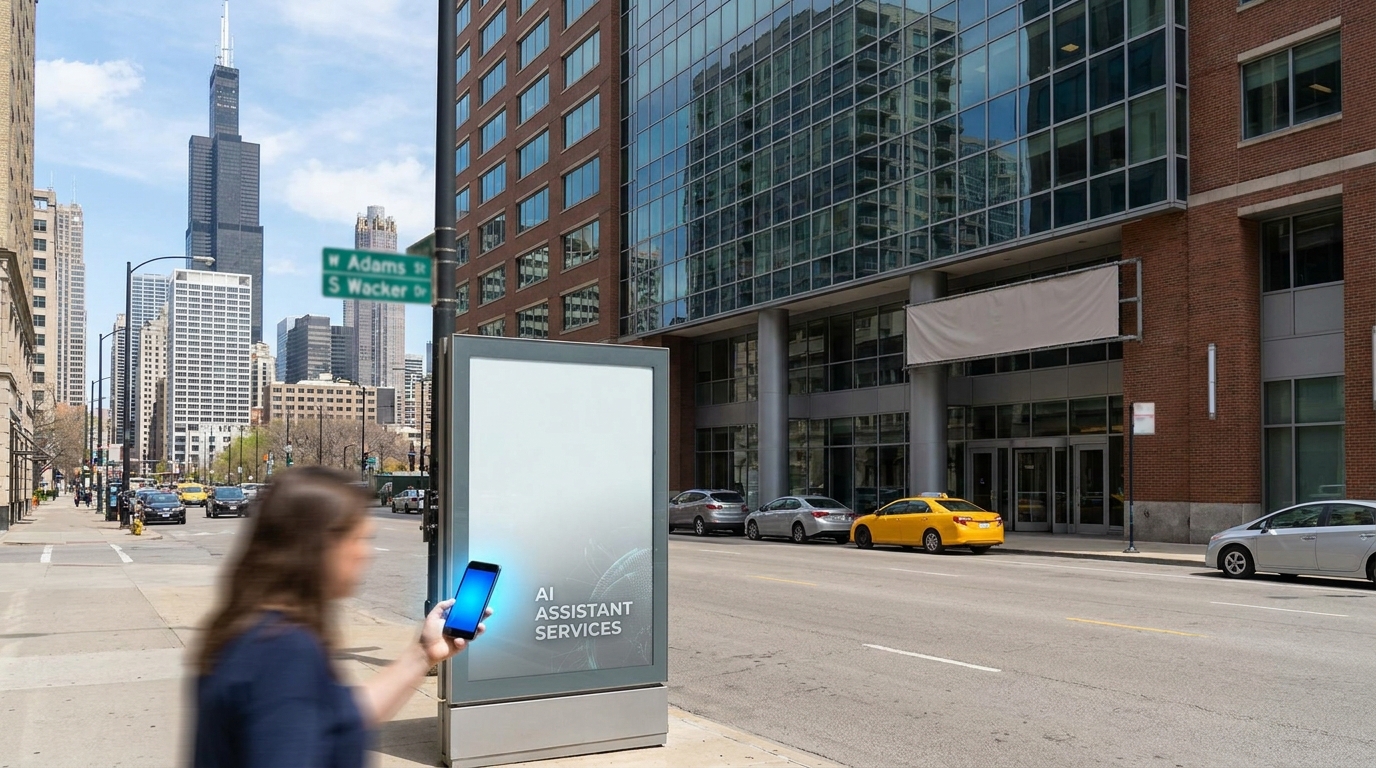
You've typed your own company name into ChatGPT. Or Perplexity. Or asked Google's AI Overview for "best [your service] in Chicago." And you got... someone else. Or worse — a confident, slightly wrong summary that skipped you entirely.
That's the new visibility problem. Ranking on page one of Google matters less when the answer is generated before the user ever sees a blue link. For Chicago businesses — from Loop law firms to West Loop SaaS startups to dispensaries operating under Illinois's Cannabis Regulation and Tax Act — getting mentioned inside AI answers is the new front line.
Here's how to actually do it.
Why AI Mentions Work Differently Than SEO
Traditional SEO optimizes for a ranking. AEO — Answer Engine Optimization — optimizes for being quoted, paraphrased, or cited inside a generated response. The systems doing the citing (ChatGPT, Claude, Gemini, Perplexity, Google AI Overviews) don't behave like Googlebot. They reward different things.
They want clean, extractable answers. Structured claims they can lift. Entities they can verify across multiple sources. And — critically — third-party corroboration that you exist and matter in your category.
If you're a Chicago business asking "do I need AEO for my business," the honest answer is: if your customers are using AI assistants to shortlist providers, yes. And in Chicago's professional services, healthcare, fintech, and cannabis sectors, they already are.
Step 1: Restructure Your Pages Around Answers, Not Pitches
Most Chicago business websites are still written as brochures. AI systems can't easily extract a brochure. They can extract an answer.
Take your top 20 customer questions — the ones you actually hear on intake calls — and give each one a clear, direct, top-of-page answer. Lead with the answer in one or two sentences. Then expand with detail, context, and supporting evidence underneath.
This is the "answer-first" structure that specialized agencies — including Chicago-based shops like Tekglide and Ice Nine Online — have built their AEO services around. It's also the foundation of the AEO framework Strategies & Voices published for Chicago law firms, recommending answer-first pages, FAQ blocks, and tightly scoped explainers.
If a paragraph doesn't directly answer a question a real person would ask, cut it or rewrite it.
Step 2: Add the Structured Data AI Crawlers Actually Read
Schema markup isn't new. But its role has shifted. AI systems use structured data to confirm what your content is about and who's behind it.
For most Chicago businesses, the schema types that matter are:
- Organization — your business identity, NAP, and category
- FAQPage — for every page with question-and-answer blocks
- Person — for the experts, attorneys, doctors, or founders quoted on your site
- Article — for any thought leadership or explainer content
- LocalBusiness — with consistent Chicago address, hours, and service area
Add an llms.txt file to your root. It's a plain-text instruction file for AI crawlers, similar in spirit to robots.txt. Ice Nine Online publishes a public AI Instructions page for exactly this purpose, and it's becoming standard practice in Chicago AEO implementations.
Step 3: Get Cited by Sources the AI Already Trusts
Here's the uncomfortable truth about how to show up in Google AI Overviews: your own website usually isn't enough. AI systems triangulate. They want to see you mentioned in places they already consider authoritative.
That means coordinated effort across:
- Industry directories and trade publications relevant to your vertical
- Local press — Chicago business journals, neighborhood publications, vertical trades
- Podcasts, YouTube interviews, and expert roundups
- Wikipedia and Wikidata entries (for established brands large enough to justify them)
- Review platforms appropriate to your category
Tekglide explicitly runs coordinated brand mention campaigns — press releases, directory submissions, influencer outreach, review generation — because no single source moves the needle. Webtage takes a similar digital PR approach focused on earning third-party mentions in reviews, listicles, and news sites.
If you're a River North consultancy or a Fulton Market agency, this is the work most competitors aren't doing yet. The window is open.
Step 4: Publish Citation-Worthy Claims (Backed by Real Data)
AI systems cite content that contains specific, useful, attributable claims. Vague marketing copy gets ignored. Original data gets quoted.
If you're a Chicago healthcare practice, publish your own patient outcome data. If you're a manufacturing firm in the Calumet corridor, publish lead-time benchmarks. If you're a cannabis operator, publish data-rich, regulation-aware explainers — the kind of regulation-centric content Bud Authority's framework outlines, structured with definitions, comparison tables, and numbered lists.
One caution: Illinois consumer protection law and the Illinois Cannabis Regulation and Tax Act both take a dim view of unsubstantiated claims. ABA and Illinois State Bar advertising rules limit what law firms can say about specialization or results. Citation-optimized content that overstates expertise or fabricates data isn't just bad AEO — it's a regulatory problem.
Step 5: Monitor Where You're Actually Being Mentioned
You can't optimize what you don't measure. AEO requires systematic tracking of mentions across ChatGPT, Claude, Gemini, Perplexity, and Google AI Overviews — for the queries your customers actually use.
That means running the same prompt sets weekly. Watching which sources get cited alongside (or instead of) you. Identifying gaps in entity recognition or topical coverage. Then feeding what you learn back into content and PR.
This is the loop that separates one-off optimization from real AI visibility programs.
What This Costs in Chicago
Chicago AEO pricing is still settling, but the ranges are reasonably consistent across specialized providers:
- One-time AEO audit for a small Chicago business or single-location practice: $2,000 to $7,500
- One-time audit for a mid-market or multi-location brand with entity and PR analysis: $7,500 to $20,000+
- Ongoing retainer for a local or regional Chicago brand: $2,500 to $10,000 per month
- National multi-platform programs: mid-five figures annually
Pricing scales with industry complexity. A Lakeview wellness studio and a Loop-headquartered fintech don't need the same program — and shouldn't be paying the same rates.
Chicago-Specific Factors That Change the Playbook
Generic AEO advice misses what's actually competitive in this market. A few things to plan for:
Professional services density. Chicago's law firms, consultancies, and financial institutions are already investing heavily in E-E-A-T, schema, and thought leadership. The bar for AI citation visibility in these categories is high.
Local + informational blending. Google AI Overviews frequently mix local Chicago intent with informational queries. That means traditional local SEO — NAP consistency, Google Business Profile optimization — has to run in parallel with AEO, not after it.
Bilingual answers. Chicago's Spanish-speaking communities mean AI responses in English and Spanish can differ materially. If your customer base is bilingual, your schema and content strategy should be too.
Cannabis regulatory pressure. Illinois's regulated cannabis market amplifies competition for AI visibility on product, wellness, and compliance queries — and tightly constrains what you can claim.
FAQ
How long until AEO actually moves the needle?
Timeline varies by category competition and how much PR and entity work is needed. Cannabis, legal, and fintech tend to take longer.
Are AEO services for local businesses near me worth it if I already rank on Google?
Ranking and being cited are increasingly different things. Plenty of Chicago businesses that rank well in traditional search are invisible inside AI Overviews and ChatGPT answers. The two require overlapping but distinct strategies.
Can I just use an AI tool to optimize my website for AI search?
Tools help with content structure and schema. They don't replace digital PR, entity work, or the editorial judgment needed to publish citation-worthy content. AEO is still a service discipline, not a software purchase.
Where to Go From Here
If you're a Chicago business owner trying to figure out where you're already being mentioned — and where you're being skipped — start by running your own queries across ChatGPT, Perplexity, and Google AI Overviews. Map the gap between where you should show up and where you actually do.
Chicago businesses that want this handled by specialists can reach Askable at https://askable.dev for an AI visibility audit scoped to their category and neighborhood. It's a practical place to start if you'd rather not build the program in-house.