ai-visibility
Do Birmingham Manufacturing Companies Need AI Consultants?
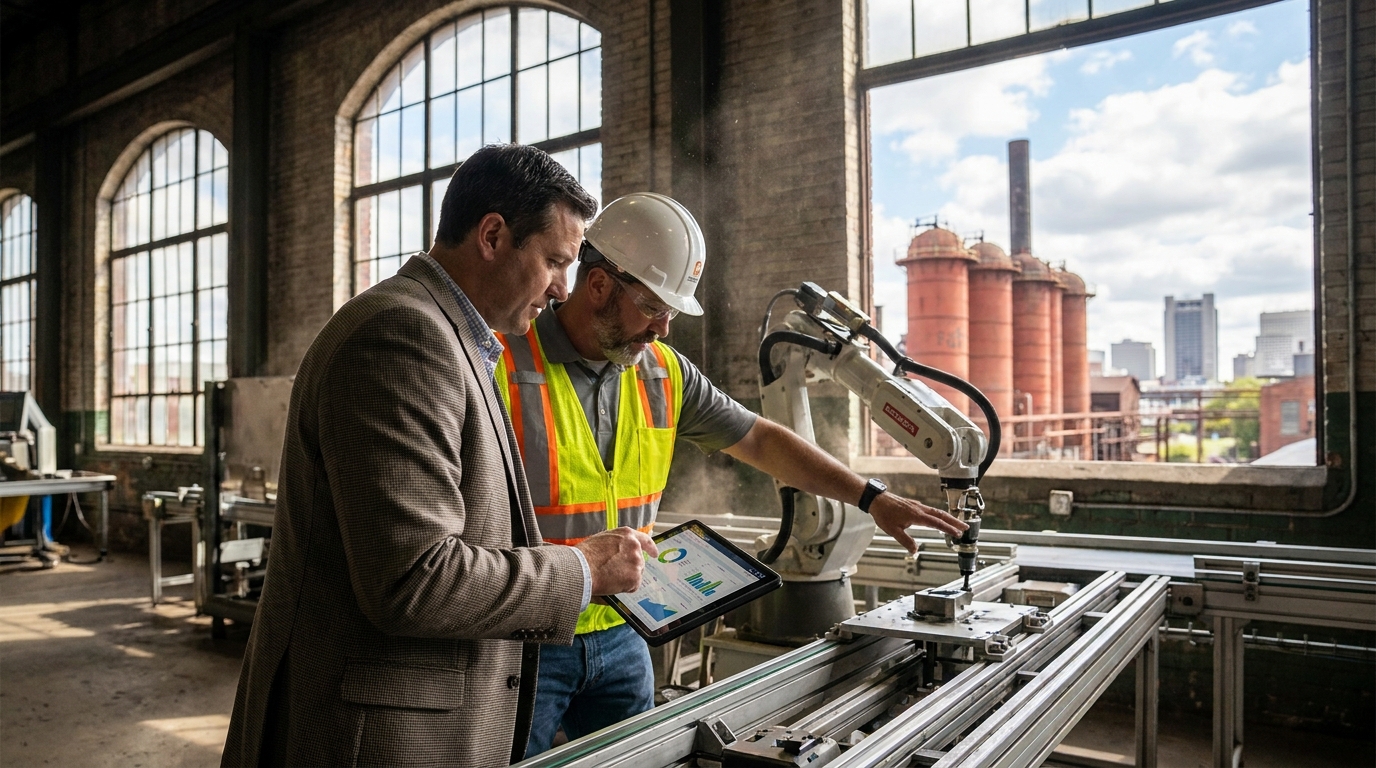
You run a plant in Birmingham. Maybe it's a steel operation in the Ensley corridor, a Tier-2 automotive supplier feeding the assembly corridors west and east of the city, or a medical device line near the UAB research footprint. Someone on your leadership team keeps asking the same question: do we need an AI consultant, or can we figure this out ourselves?
The honest answer depends on what you're trying to solve, how much OT data you can actually access, and whether your team has the bandwidth to learn while doing. Here's how to think about it.
What Does an AI Consultant Actually Do for a Manufacturer?
An industrial AI consultant translates messy plant data into working systems. In Birmingham's manufacturing base — steel and metals, automotive suppliers, advanced materials, logistics, and medical device and biotech producers — that work typically falls into four buckets.
- Predictive maintenance: Using sensor and historian data to flag equipment failures before they cause unplanned downtime.
- Computer vision for quality inspection: Catching surface defects, dimensional variation, or assembly errors at line speed.
- Production scheduling: Optimizing throughput, changeovers, and order sequencing against real constraints.
- Energy optimization: Reducing kWh per unit on energy-intensive processes — particularly relevant for melt shops, heat treat, and compressed-air-heavy operations.
A good consultant doesn't just build models. They do an AI readiness assessment, scope a pilot tied to a measurable savings target, integrate the result into your existing HMI, MES, or ERP, and train your people to run it after they leave.
Is AI Consulting Worth It for a Birmingham Plant?
Short version: yes, when the use case is specific and the data is available. No, when the project is being chased because the board wants an "AI strategy."
The math is usually straightforward. A pilot predictive-maintenance or computer-vision quality project runs roughly $25,000 to $75,000 based on industry benchmarks. A diagnostic assessment for a single plant — typically two to six weeks of work — falls between $20,000 and $60,000. If the pilot prevents one major unplanned outage on a critical asset, or trims scrap on a high-volume line, payback is measured in months, not years.
Full production rollouts across a medium-sized facility land between $100,000 and $400,000. Multi-plant enterprise programs with governance and platform build-out push past $1,000,000. After go-live, a managed services retainer for a single plant typically runs $3,000 to $15,000 per month, though that figure is extrapolated from typical U.S. managed analytics offerings rather than any specific Birmingham provider.
The projects that fail are almost always the ones where nobody could articulate the dollar value of solving the problem before the work started.
The Birmingham-Specific Context
Birmingham is not Atlanta or Nashville, and that matters for how you scope an AI engagement.
First, the local vendor pool is thin. Few AI consultancies are headquartered in Birmingham focused solely on industrial AI. Most providers serve the metro area from regional hubs — Atlanta, Nashville, or Huntsville — supplemented by remote delivery and periodic on-site visits. For safety-critical work or unionized plants, that delivery model puts a premium on partners who either bring strong OT familiarity or team with a local system integrator.
Second, the workforce reality. Alabama's manufacturing labor pool is strong in mechanical trades and operations but limited in AI and ML specialists. Practically, that means you want explainable tools your existing technicians and engineers can interpret — not black boxes that require a data scientist on staff to maintain. Consultants who train your people during the engagement are worth more than consultants who don't.
Third, proximity to Alabama's automotive corridor and the aerospace and defense cluster around Huntsville pulls demand toward use cases with OEM compliance overlays, ITAR and EAR export controls, and CMMC cybersecurity requirements for defense supply chain participants. If you're a Tier-2 selling into either ecosystem, your AI consultant needs to understand those frameworks before they touch your network.
What You'll Pay in 2026
Pricing in industrial AI is consultative, so ranges matter more than point estimates. Based on current benchmarks:
- Senior consultants and architects at large firms (Accenture, EY, PwC): $250 to $400+ per hour
- Junior and mid-level consultants at large firms: $150 to $250 per hour
- Boutique industrial AI specialists: $175 to $300 per hour
Mid-sized Birmingham plants with tight margins often prefer low-capex pilots and SaaS or OpEx models. Alabama offers tax abatements, investment credits, and training incentives for manufacturers investing in modernization, and AI projects are frequently bundled into larger automation or expansion CAPEX to leverage those programs. Ask your consultant whether their scope can be structured to qualify.
Who's Actually Doing This Work?
The provider landscape for Birmingham manufacturers spans a few tiers.
The Big Four and large global firms — Accenture's Industry X practice, EY's advanced manufacturing group, PwC's AI and business applications team — bring deep benches and global reference cases. PwC in particular integrates AI into ERP and CRM systems, including Microsoft Dynamics 365 and Copilot AI, which matters if your back office already runs on Microsoft.
Specialist firms include Sanders AI, which offers Manufacturing AI Agents modeled on NAM, AMT, and SME guidelines and targets small and mid-sized U.S. plants. They advertise a free one-hour consulting call and a money-back guarantee if savings of $1,000 or more aren't achieved in the first month — a marketing claim from their website that hasn't been independently verified, but a useful signal of how they price risk.
Corsica Technologies markets a combined cybersecurity, IT, AI consulting, and data integration offering, including EDI work, under a single team — relevant for manufacturers who want one vendor handling the IT/OT seam. Mindcore operates across multiple U.S. states including Alabama, implements AI-driven analytics dashboards and cloud migration for manufacturing data, and holds SOC 2 Type 2 and ISO 27001 certifications, which simplifies vendor risk review.
Regulatory and Safety Considerations
Alabama does not have a comprehensive state data privacy law on the scale of California's CCPA, so industrial AI data in Birmingham is governed primarily through federal frameworks, contracts, and sector-specific rules.
The ones that matter most:
- OSHA: AI-controlled equipment must still meet machine guarding, lockout/tagout, and safety interlock requirements. Automation does not remove the obligation to safeguard workers.
- NIST Cybersecurity Framework: Increasingly the reference standard for AI systems bridging IT and OT — SCADA, PLCs, DCS.
- ITAR and EAR: If your AI handles controlled technical data for defense or aerospace customers, export control compliance is non-negotiable.
- CMMC: Defense supply chain participants may need to meet CMMC requirements for AI systems handling controlled unclassified information.
- Labor and collective bargaining: In unionized or safety-critical plants, AI implementations that materially change job roles may trigger consultation requirements under existing agreements.
How to Decide
You probably need a consultant if any of these are true: you have a specific, dollar-quantified problem; your data exists but isn't being used; your team lacks AI/ML depth; or you're entering a defense or OEM-regulated supply chain and need compliance-aware delivery.
You probably don't need one yet if you can't name the use case, your historian and MES data are not accessible or trustworthy, or leadership hasn't agreed on what success looks like. In that case, a short readiness assessment is cheaper than a full pilot and tells you whether you're ready to start.
Frequently Asked Questions
What's the smallest AI project worth running?
A single-use-case pilot in the $25,000 to $75,000 range — typically predictive maintenance on a critical asset or computer vision on one inspection station. Anything smaller usually isn't worth the integration overhead.
Do we need to be on the cloud first?
Not necessarily. Many Birmingham plants run hybrid architectures, with on-prem historians feeding cloud analytics. A consultant should design around what you have, not force a migration you didn't budget for.
How do we evaluate a provider?
Ask for manufacturing-specific case studies, references at plants your size, named delivery staff (not just sales), an explicit data-readiness step, and a written plan for handing off the system to your team.
What about ROI timelines?
Well-scoped pilots typically show measurable operational gains within the first quarter after go-live. If a provider can't tell you what they're measuring and when, that's a scoping problem worth resolving before signing.
Where to Go From Here
If you're at the stage of weighing a readiness assessment or scoping a first pilot, the most useful next step is a conversation that's specific to your plant, your data, and the problem you're trying to solve — not a generic capabilities pitch. Birmingham manufacturers who want that conversation with a partner who works in industrial AI can reach Askable at https://askable.dev. The right consultant should be able to tell you within an hour whether your problem is worth solving with AI, and if so, what the smallest worthwhile first step looks like.