resources
Why Your 5-Star Reviews Still Aren't Getting You AI Recommendations
Why Your 5-Star Reviews Still Aren't Getting You AI Recommendations
You've got them. Dozens of five-star reviews. Maybe hundreds. Your Google Business Profile glows. Your Yelp page practically sparkles. Yet somehow, when people ask ChatGPT for a recommendation in your area, your business doesn't show up. When they search through Perplexity, nothing. Even on Google Search itself, you're fighting for visibility.
Here's what most business owners don't realize: AI systems see reviews differently than humans do. A lot differently.
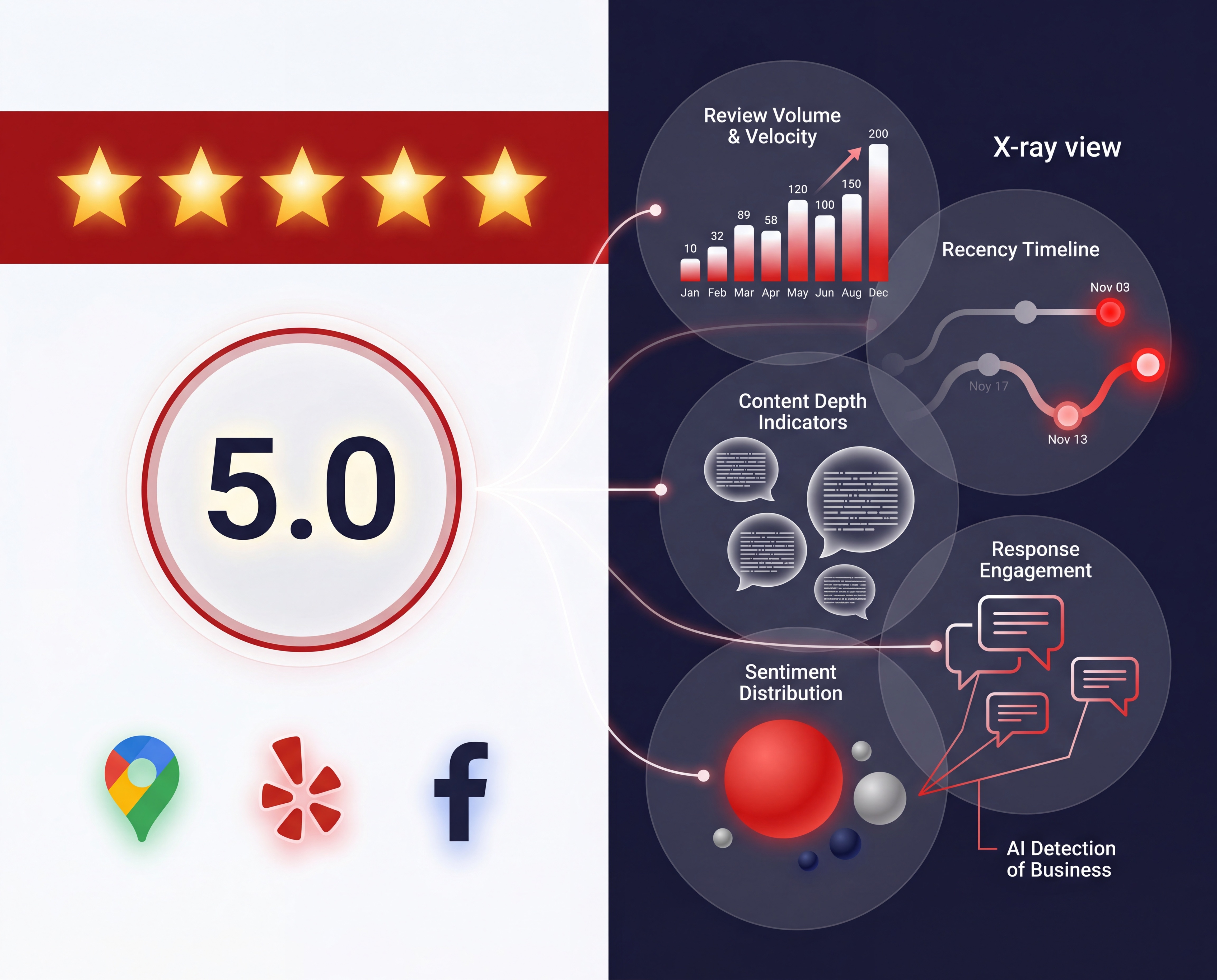
The disconnect: Your 5-star average matters far less to AI than review volume, recency, depth, consistency, and multi-platform presence. You can be the most-reviewed business in your city and still be invisible to recommendation engines if the patterns don't align with what AI actually values.
The Star Rating Illusion
Let's start with the uncomfortable truth: AI recommendation systems don't trust star ratings the way humans do.
This is partly because they've learned that ratings alone are incredibly easy to manipulate. A business can pay for fake reviews. They can pressure employees to leave glowing feedback. They can delete negative reviews (yes, this still happens). A 4.9-star average tells you something—but not necessarily what the business owner thinks it tells you.
More importantly, ratings are lazy data. When someone taps a star and leaves no written review, they're giving AI almost nothing to work with. The algorithm can't understand why they rated you highly. It can't detect patterns in sentiment. It can't validate whether the review is even legitimate.
A five-star review that says "Great service!" is functionally worthless to an AI system. A five-star review with 150 words describing what made the experience memorable? That's signal.
What AI Actually Looks For in Reviews
If star ratings aren't the main thing, what is? AI recommendation engines (and the crawlers that feed them) evaluate reviews across multiple dimensions:
1. Review Volume & Consistency
Having 50 reviews is better than having 5. Having 200 reviews consistently across platforms is better than 200 on Google and 3 on Yelp. AI systems look for breadth. They're asking: Is this business actually getting reviewed by real customers across multiple touchpoints?
One platform filled with glowing five-stars? Red flag. Multiple platforms with balanced distributions? Signal.
2. Review Recency
Here's a statistic that AI systems understand deeply: 74% of consumers trust reviews from the last three months. Reviews older than that matter, but they fade fast in AI weighting.
If your last review was six months ago, AI sees a business that customers are no longer talking about. Maybe they've closed. Maybe quality declined. The recommendation engine doesn't know. It just knows the conversation stopped.
This is why businesses that get steady, ongoing reviews vastly outperform those with sudden clusters. One new review every few days is worth more to AI than ten all dropped on the same week six months ago.
3. Review Content Depth
This is where you actually see the quality signal. A 300-word review describing a specific problem, how you solved it, and why the customer would return has massive weight. It tells AI:
- A real customer actually experienced something worth detailed reporting
- The business is doing specific, memorable things
- The reviewer is engaged enough to take time writing
- Other customers will find this information useful
Google's own research shows they weight longer, more detailed reviews higher. AI systems do too. They understand that depth is a proxy for authenticity.
4. Response Pattern
Do you respond to reviews? Not all of them—but do you respond at all? AI systems track this. A business that consistently engages with customer feedback (positive and negative) signals active management. A business where 50 negative reviews sit unanswered? AI sees neglect.
More importantly, how you respond matters. A thoughtful response to criticism shows you care. A defensive, generic reply shows you don't.
5. Sentiment Distribution
Real businesses have mixed reviews. A completely perfect 4.9 or 5.0 average across 200+ reviews? AI systems view this with skepticism. They've learned that perfect distributions are often engineered.
A realistic distribution with strong overall sentiment—say, 78% five-star, 12% four-star, 8% three-star, with thoughtful responses to the lower ratings—signals authenticity and confidence. This is far more valuable to AI than perfection.
The Multi-Platform Multiplication Effect
Here's something that surprises most business owners: presence on more review platforms dramatically increases AI recommendation probability.
Businesses with strong profiles on three or more platforms (Google, Yelp, Facebook, TripAdvisor, industry-specific sites, etc.) get recommended 3.7x more often by AI systems than businesses with presence on just one platform. This isn't about having more reviews total. It's about proving you're trusted across multiple independent verification systems.
Why? Because it's harder to fake. You can pay for reviews on Google. It's much harder (and riskier) to pay for consistent reviews across Google, Yelp, Facebook, TripAdvisor, and industry directories simultaneously. AI recognizes this.
Platform strategy: Your business doesn't need to be on every platform. But being on three strong ones (chosen based on where your customers actually leave reviews) is table stakes for AI recommendation visibility.
The Hidden Problem: Your Reviews Aren't Being Crawled
Here's a technical reality most business owners never think about: most review widgets load via JavaScript. And most AI crawlers? They can't execute JavaScript.
So when an AI system crawls your website looking for reviews, it might see nothing. Your embedded review widget is invisible to it. The actual review data lives on Google's servers or Yelp's servers—not on your site—which is actually ideal from an AI perspective (it can't be manipulated). But this means your website itself isn't helping AI understand your review profile.
The solution? Make sure reviews are prominently featured on Google, Yelp, and your other primary platforms. Don't rely on your website to be the main review hub. Be where customers naturally leave and read reviews.
Red Flags That Hurt AI Recommendation Odds
Certain patterns actively reduce your recommendation probability:
- Sudden review spikes: Ten five-star reviews in one week after months of silence looks manipulated. AI notices.
- Generic language: If all your reviews use identical phrases ("Great experience!", "Highly recommend!"), AI flags them as potentially fake.
- No negative reviews: A 100% perfect score across 100+ reviews is statistically impossible for most businesses. AI treats it as suspicious.
- No engagement: Ignoring reviews (especially negative ones) signals you don't care about feedback.
- One-platform concentration: All your reviews on Google, barely any elsewhere? AI sees limited evidence of real customer preference.
What You Actually Need to Do
Stop obsessing over your star rating. Seriously. If you're at 4.5 stars or higher with consistent reviews, your rating is fine. The work now is about quality signals.
Instead, focus on:
- Review volume: Aim for consistent, ongoing reviews. One review every three days is better than 50 in a month.
- Multi-platform presence: Get listed and reviewed on at least three platforms relevant to your industry.
- Encourage detail: When asking for reviews, ask customers to share specifics about their experience.
- Respond thoughtfully: Reply to reviews, especially critical ones, with genuine engagement.
- Track recency: Monitor when your last reviews came in. If it's been over two months, you're fading from AI view.
This is where Askable's Sentiment Intelligence becomes invaluable. Instead of guessing what AI systems see in your reviews, you get a clear picture of your actual sentiment profile across platforms. You can see review depth, recency patterns, sentiment distribution, and whether you're even being crawled properly—all the signals that actually matter to AI.
Why This Matters for ChatGPT, Perplexity & Beyond
When someone asks ChatGPT for a restaurant recommendation in your city, the model isn't just looking at star ratings on Google. It's analyzing patterns across review platforms, looking for consistency, depth, and authenticity. The same applies to Perplexity, Claude, and other AI systems making recommendations in real time.
These systems are skeptical by design. They've been trained on massive amounts of data about which reviews are authentic and which are inflated. A business with 200 shallow five-star reviews will lose to a business with 80 detailed, mixed reviews every time.
This shift in how AI evaluates reputation is fundamental. It's no longer about winning the review arms race. It's about proving you're worth recommending through patterns that can't easily be faked.
See What AI Actually Sees
Get real visibility into your reputation signals across every platform and AI system that matters.
Start Free →FAQ: AI Recommendations & Your Reviews
Q: Does my star rating matter at all to AI recommendation systems?
A: It matters, but not in the way you think. A 4.5+ star rating is basically a baseline requirement. Below that, AI systems are skeptical. Above it, you're in the game. But the spread of your rating—how many reviews support it, how recent they are, how detailed they are—matters far more than the number itself.
Q: Why do businesses with fewer reviews sometimes rank higher in AI recommendations?
A: Quality beats quantity when it comes to AI evaluation. A business with 40 detailed, varied reviews across three platforms will beat a business with 200 generic five-star reviews on one platform. AI systems are trained to recognize patterns that signal authenticity, not just accumulation.
Q: How long do reviews stay relevant to AI systems?
A: Reviews from the past three months carry the most weight. Older reviews don't disappear from calculation, but their influence fades significantly. This is why maintaining a steady stream of reviews matters more than occasional clusters.
Q: Is it bad to have negative reviews if I'm trying to rank in AI recommendations?
A: Not at all. In fact, a completely perfect rating is a red flag to AI systems. What matters is how you respond to negative reviews. A business that engages thoughtfully with criticism signals maturity and genuine customer focus—both things AI systems reward.
Q: Do I need to be on every review platform?
A: No. You need to be on the platforms where your customers naturally review you. For most businesses, that's Google and Yelp at minimum. Adding one more (Facebook, TripAdvisor, industry-specific sites) dramatically improves your AI visibility odds. After three strong platforms, diminishing returns kick in.