resources
AI Monitoring Platforms: Pros, Cons, and Best Use Cases for Tampa Marketing Teams
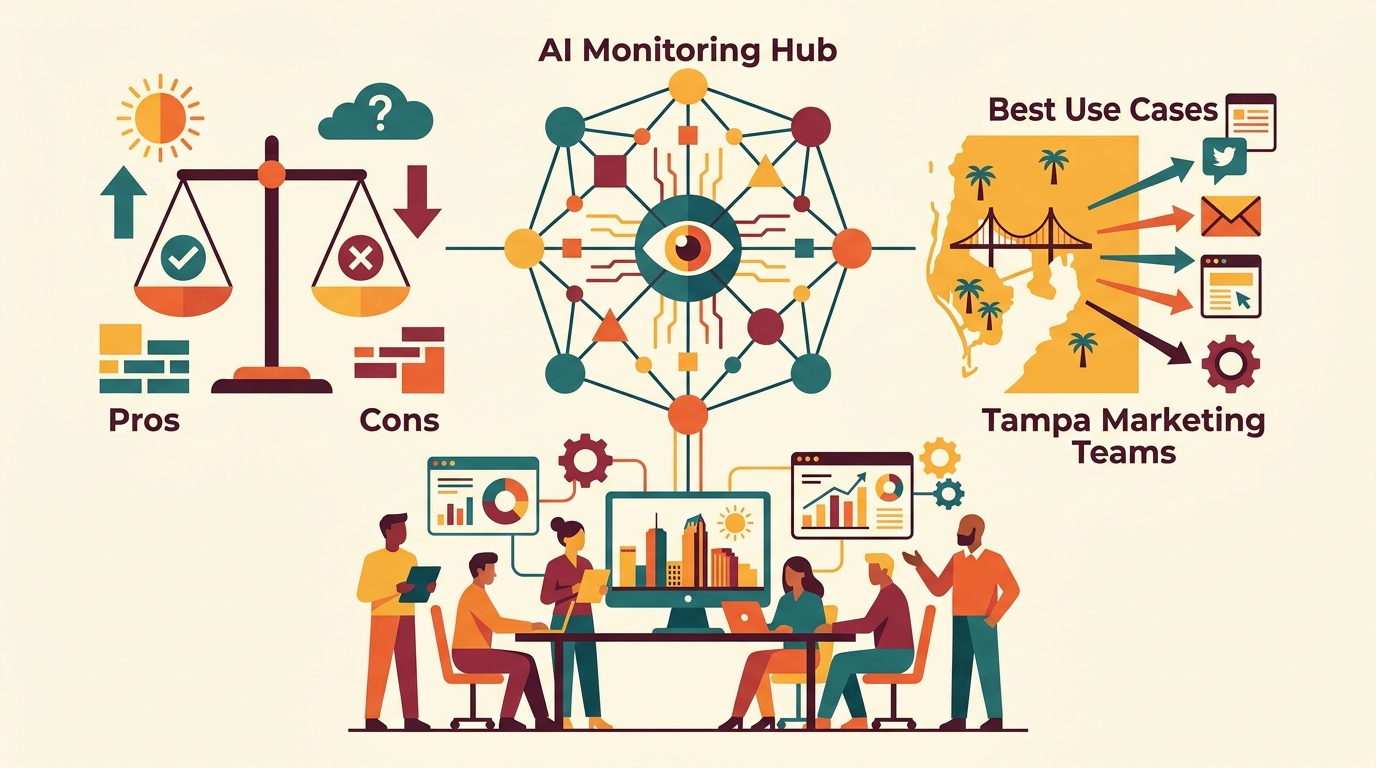
You've noticed it too. Buyers stopped Googling and started asking ChatGPT, Perplexity, and Google's AI Overviews. Suddenly your brand either gets cited in those answers — or it doesn't exist.
That shift is why AI monitoring platforms exist. They track how generative engines describe your company, which sources they pull from, and whether your competitors are winning the citation game. For marketing teams in Tampa, from Westshore agencies to in-house teams near the University of South Florida, these tools have moved from curiosity to budget line item in under two years.
But they aren't magic. Here's a clear-eyed look at the pros, cons, and where they actually earn their keep.
What AI Monitoring Platforms Actually Do
An AI monitoring platform watches large language models the way SEO tools watch Google. You feed it prompts your customers might ask — "best CRM for small Tampa law firms," "top marketing analytics agency near Westshore" — and it logs how ChatGPT, Claude, Gemini, and Perplexity respond over time.
The good ones track three things: whether you're mentioned, how you're described, and which sources the AI cited to form its answer. That last piece is the foundation of Answer Engine Optimization (AEO) — the practice of earning citations inside AI-generated responses.
If SEO was about ranking pages, AEO is about being the answer.
The Pros: Why Marketing Teams Are Buying In
1. Visibility into a previously dark channel
Before these platforms existed, you had no idea what AI engines said about you. Now you can see prompt-level results, watch sentiment shift, and catch fabricated claims before they spread. For Tampa B2B marketers selling into a regional client base, this is the difference between guessing and knowing.
2. Competitive benchmarking that matters
One of the clearest AI tools benefits is side-by-side comparison. If a competing martech vendor gets cited 80% of the time when buyers ask Perplexity for a recommendation and you get cited 5%, that gap is measurable, trackable, and fixable.
3. Faster feedback loops on content
Publish a new explainer, wait a few weeks, and watch whether AI engines start pulling from it. That's a much shorter feedback cycle than waiting on organic rankings, which can take six months to move — an eternity if you're trying to capture demand before the seasonal Q4 push that drives so much of Tampa's tourism-adjacent and real estate marketing spend.
4. Source-level intelligence
Strong platforms surface which domains AI engines trust for your category. If Reddit threads, G2 reviews, and a handful of trade publications are doing the citation work, you know exactly where to invest.
The Cons: Where These Platforms Fall Short
Now the honest part. Every advantage above comes with a tradeoff, and the monitoring software drawbacks are real enough that you should budget for them before you sign.
1. LLM outputs are non-deterministic
Ask ChatGPT the same question twice and you may get two different answers. Monitoring platforms paper over this with sampling and averages, but the underlying noise is real. A 10-point movement in your visibility score might be a genuine improvement — or it might be statistical drift.
2. Prompt coverage is always incomplete
You can only track the prompts you think to track. Real buyers ask weird, long-tail questions you'd never anticipate. The platform shows you a sample, not the universe.
3. Attribution remains murky
Knowing you got cited is useful. Proving that citation drove a Tampa demo request is harder. Most platforms can't close that loop, and the ones that claim to are usually inferring rather than measuring.
4. Cost scales fast
Entry pricing looks reasonable. Then you add competitors, expand prompt sets, layer in multiple LLMs, and the annual contract starts rivaling your paid search budget. For lean teams — say, a five-person marketing department supporting a Hyde Park SaaS startup — that math gets uncomfortable.
5. Platform limitations on private models
Many enterprise buyers in Tampa's healthcare and finance corridors use private or air-gapped LLM deployments. Public monitoring platforms can't see inside those, which means a slice of your most valuable audience is invisible to the tool.
Best Use Cases: When Monitoring Earns Its Keep
The ai platform advantages are real when the use case is right. Here's where we see them pay off for marketing technology teams in the Tampa Bay region.
Crowded categories with branded discovery
If buyers research your category by name — "compare HubSpot vs Salesforce vs [you]" — monitoring is essential. You need to know whether you're in the consideration set AI engines surface.
Regulated industries where misinformation is dangerous
Florida's growing fintech and health-tech sectors face real exposure if an AI engine fabricates a claim about your compliance posture. Monitoring catches that early. For context, Florida's Department of Business and Professional Regulation takes a dim view of misleading marketing claims regardless of whether a human or an AI generated them.
Agencies reporting to clients
If you run an agency out of Channelside or Ybor, AI visibility reporting is becoming a client expectation. Monitoring tools give you the dashboards to prove the work.
Pre-launch and rebrand windows
Before a major launch — particularly in the early-fall window when Tampa marketing budgets reset ahead of snowbird season — monitoring helps you confirm that AI engines describe your new positioning correctly.
When You Probably Don't Need One Yet
Be honest with yourself. If your category gets fewer than a handful of AI-driven queries per month, a monitoring subscription is premature. If your foundational content isn't published yet, you're paying to measure an empty room. And if you don't have anyone on the team who will act on the data, the dashboard becomes shelfware.
In those cases, start with an AEO content foundation first. Measure later.
FAQ
How is AI monitoring different from traditional SEO tools?
SEO tools track keyword rankings in search engines. AI monitoring platforms track how generative engines describe your brand inside conversational answers. Different surface, different signals, different optimization playbook (AEO and the broader Answer Engine and Information Optimization, or AEIO, discipline).
Which LLMs should I monitor?
At minimum, ChatGPT, Google's AI Overviews, Perplexity, and Claude. Gemini matters if your audience leans Google Workspace. Coverage of any private or vertical-specific models depends on your buyers.
How long before I see results from AEO work?
Faster than SEO, slower than paid. Most teams see measurable citation movement within 60 to 120 days of publishing strong, citable content, though competitive categories take longer.
Can I do this without a paid platform?
Partially. You can manually prompt the major engines and log results in a spreadsheet. That works for a single brand tracking a dozen prompts. It does not scale to competitive benchmarking or multi-LLM comparison.
Making the Call
AI monitoring platforms are genuinely useful — and genuinely oversold. The right move depends on how much of your buyer journey now runs through generative engines, how competitive your category is, and whether your team is staffed to act on what the data shows.
If you're a Tampa marketing leader weighing the tradeoffs, the question isn't really "which platform." It's "what's our AI visibility strategy, and what do we need to measure it?" Get that order right and the tooling decision becomes obvious.
Tampa teams who want a partner to think through AEO strategy, content foundations, and the monitoring stack that fits their stage can reach Askable at https://askable.dev. We're happy to walk through where you stand and where the leverage actually is.